Most of us grew up on a simple bargain. You trade your hours for a paycheck, spend some of it, and stash the rest, and if you keep that up for long enough, the saving is supposed to turn into something like security.
The machinery behind that bargain rarely changes. Prices drift higher most years. The Federal Reserve fights to keep that drift from turning into a sprint. And the advice handed down to working people almost never wavers. Earn, save, repeat, and brace for the day your dollar buys less than it did the year before.
Inflation, in other words, is the villain nearly everyone has been trained to watch. It is the quiet force that thins a fixed income and turns a routine grocery run into a small jolt of sticker shock.
Now one of the most powerful people alive says the country is bracing for the wrong fight entirely. Tesla (TSLA) CEO Elon Musk argued in a June 21 post on X that once artificial intelligence (AI) is running the economy, the government should simply hand people cash, and the real danger ahead will not be prices going up. It will be prices falling.
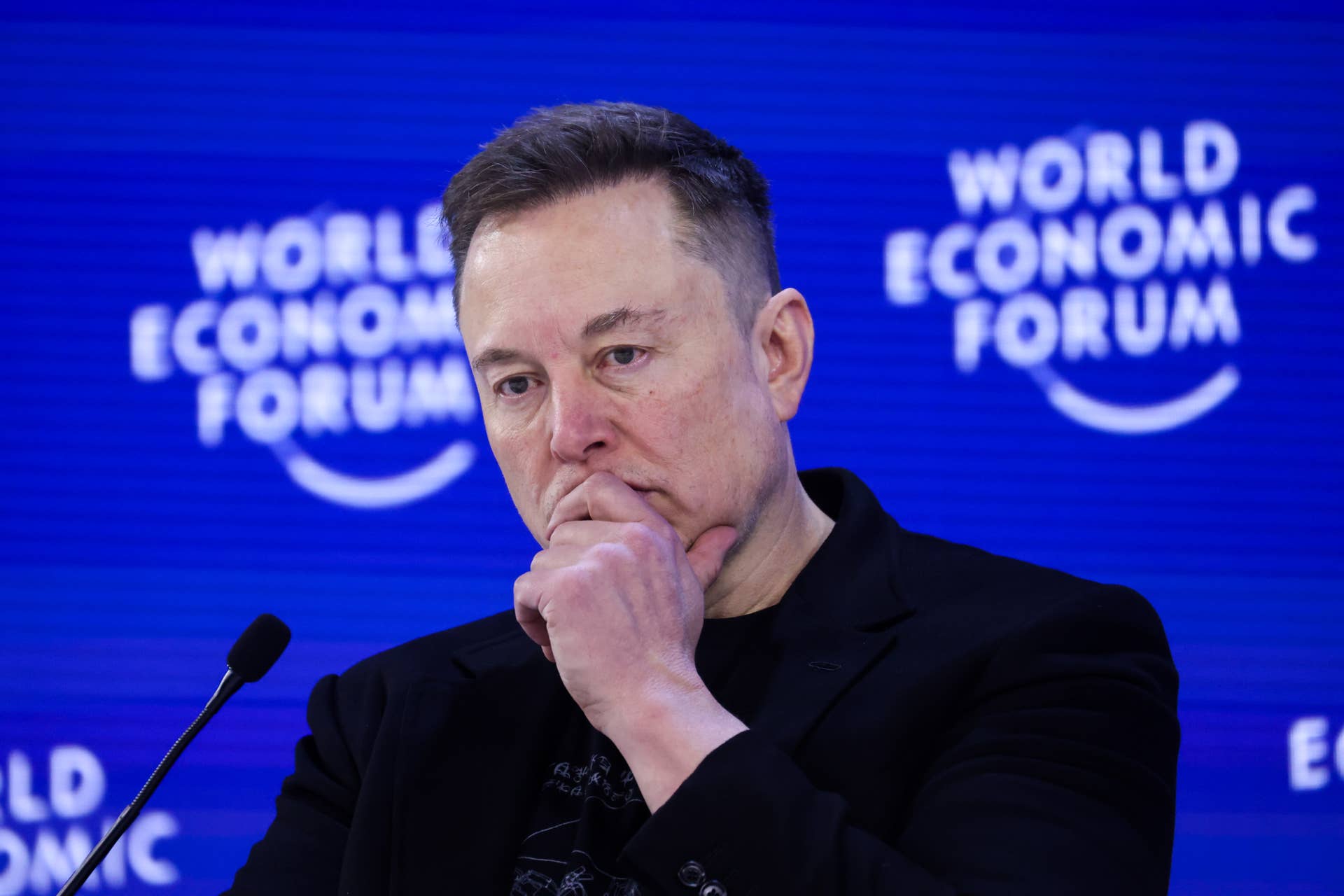
Bloomberg / Getty Images
The debt math driving Musk’s prediction
To understand why Musk keeps landing here, start with the number that seems to keep him up at night. The U.S. national debt has climbed past $38 trillion, according to the Committee for a Responsible Federal Budget. Interest on that pile is on track to top $1 trillion this year, more than the country spends on its entire military, the same group reported.
More AI:
- OpenAl admits enterprises need better control over Al costs
- SpaceX stock joins Al bond frenzy
- JPMorgan and Anthropic lead massive new AI operational shift
Musk has been circulating this idea for a while. He said last year that a universal high income is coming, an upgrade from the older notion of a modest safety net, as covered in my TheStreet report.
When I traced his economic commentary back several years, the through-line stayed remarkably consistent. His bet is that AI and the robots it powers will flood the economy with goods and services far faster than the government can expand the money supply. In that world, he argues, the textbook rule that printing money causes inflation quietly breaks, because suddenly there is so much more to buy.
Related: Elon Musk’s SpaceX is coming for your 401(k)
What sending money straight to people would mean
Here is the part that will catch most readers off guard. The fix, Musk wrote in his post on X, is for the Treasury to “send money directly to the people,” because in an AI-run economy “we will desperately be fighting deflation.”
His reasoning runs straight through the money supply. Inflation, in Musk’s framing, is just the ratio of how much stuff the economy makes to how much money is sloshing around chasing it. Build enough cheap goods with machines, and prices have nowhere to go but down. He has even put a rough clock on it, telling a podcast that meaningful deflation could arrive within three years, with interest rates eventually drifting toward zero, according to Fox Business.
The stakes behind that argument are not abstract:
- The national debt has pushed past $38 trillion, according to the Committee for a Responsible Federal Budget.
- Interest payments alone are set to exceed $1 trillion this year, surpassing defense spending, the same group reported.
- AI was cited as the reason for roughly 55,000 announced U.S. job cuts in 2025, according to Challenger, Gray & Christmas.
Direct payments, in this telling, are not charity. They are the plumbing that keeps money moving once a paycheck stops being the main way most people get paid. Strip away the science fiction and Musk is making an old argument in a new outfit. When machines do the producing, the question is no longer how to create wealth. It is how to put it in people’s hands.
Why economists are not sold on deflation
This is where I get skeptical. Plenty of economists agree AI will push some prices down. Most of them call that effect disinflation, a slowing of price increases, rather than outright deflation, where the broad price level actually falls. BlackRock (BLK) executive Rick Rieder has described AI as a “force that pushes unit costs down and output up,” according to Fortune, which is a long way from saying the whole price level caves in.
The trend in the labor market is also messier than a single statistic suggests. AI was directly blamed for less than 1% of the roughly 1.1 million job cuts U.S. employers announced in 2025. The fear, more than the body count so far, is what unsettles people. Companies keep citing AI as they restructure, even when a human executive made the call. The scale further out is what feeds the anxiety. The World Economic Forum projects that 92 million jobs could be displaced globally by 2030, even as new kinds of work are created.
Then there is the bill. Critics argue that cutting checks to every American, on top of $38 trillion in existing debt, could break the very government Musk says the payments would protect. Even sympathetic readers of his work have struggled to find a dollar figure or a funding plan anywhere in it.
For your money, the gap between Musk’s vision and the present matters more than whether he is eventually proven right. Deflation sounds pleasant until you have to live inside it. Falling prices push people to delay purchases, which starves the economy, and they make existing debt heavier in real terms, since you end up repaying yesterday’s loans with tomorrow’s more valuable dollars. Wages tend to stall or slide in that environment too, which is the quiet reason direct payments sit at the center of Musk’s plan rather than at its edge.
What the AI economy means for your wallet
The honest read is that Musk is describing a destination without handing anyone a map. The AI-driven abundance he keeps promising may genuinely show up. The Treasury checks he wants to cushion the landing are nowhere on any legislative calendar in Washington.
So the practical move is to treat his forecast as a scenario, not a strategy. Keep saving, keep your income sources varied, and watch the signals that would actually confirm his thesis. Are prices starting to fall across the board, and is the Fed being forced to chase rates back toward zero?
Because the one piece of Musk’s prediction already coming true is the piece he says the payments would fix. The machines are taking the jobs first. The checks, if they ever clear, would arrive a long way behind. For now, the smartest position is the boring one. Build a cushion that holds up whether prices rise, fall, or simply refuse to behave.
Related: Elon Musk drops trillion-dollar message to SpaceX investors
#Elon #Musk #radical #fix #AIdominated #economy