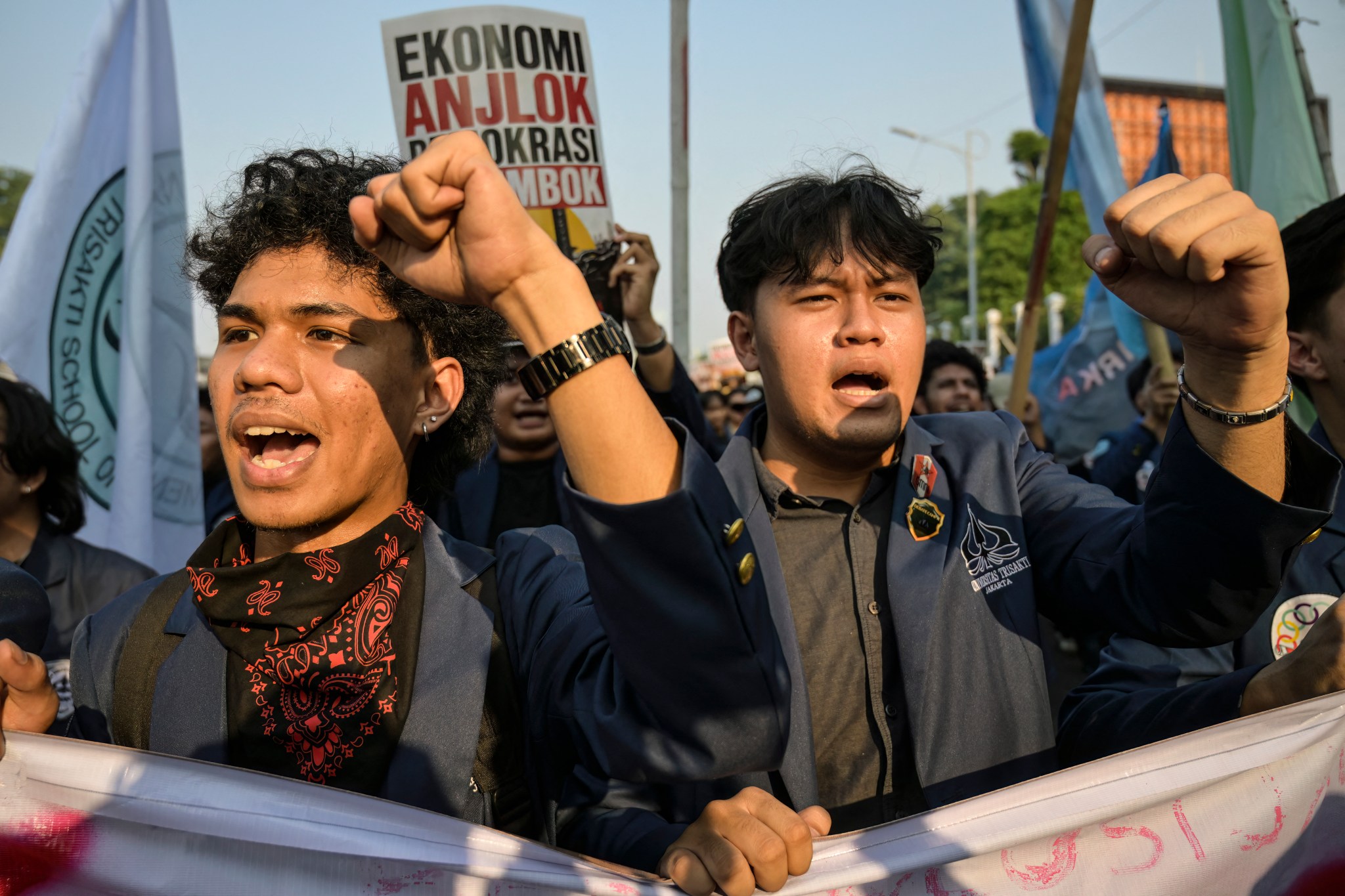
The day of reckoning for Indonesia’s stock market is here. MSCI, the global benchmark provider, will determine whether to downgrade Southeast Asia’s largest economy to “frontier market” status, or keep it as an emerging market, on June 23. If MSCI downgrades Indonesia, as much as $13 billion could flow out of the country, as calculated by Goldman Sachs.
“If MSCI confirms a downgrade, index funds would sell Indonesian holdings automatically,” Achmad Sukarsono, associate director at consultancy Control Risks, tells Fortune. “No committee needs to make a grand judgment, as the rules do the selling.”
The fallout won’t stop there. “A downgrade is a loud signal to everyone else that something is wrong,” says Josh Kurlantzick, a senior fellow for South and Southeast Asia at the Council on Foreign Relations (CFR), a New York City-based think tank. “Fund managers who actively choose where to invest would likely back away from Indonesia too.”
MSCI first raised concerns over Indonesia’s investability in late January, pointing to opacity in ownership data and market activity. It also announced an interim freeze on index adjustments for Indonesian securities. (Other MSCI frontier markets include Bangladesh, Pakistan, and Vietnam.)
This triggered a massive sell-off of Indonesian stocks. Foreign investors have pulled $3.4 billion out of the Jakarta stock exchange since the start of 2026. The country’s stock market is now one of the world’s worst-performing, with the Jakarta Composite Index falling over 28% in 2026 thus far.
Long-drawn issue
MSCI designated Indonesia an emerging market in 1989, following a series of major financial reforms that opened its stock market to foreign investors. Indonesia has long attracted investors due to its bounty of natural resources and its large and growing population.
“Indonesia still has scale, demographics, strategic minerals, a large domestic market, and a political class that understands growth,” says Sukarsono. “The problem is confidence in the people making policy.”
Despite its “solid fundamentals”, Indonesia experienced economic and political instability after President Prabowo Subianto took office in 2024. Several policies by Prabowo’s administration—including his multi-billion dollar free meals program and the administration’s decision to give more responsibility to new sovereign wealth fund Danantara—are concerning investors worried about fiscal strain on the government and an increasing state presence in the economy. (Rating agencies Moody’s and Fitch downgraded Indonesia’s sovereign rating outlook to negative in February and March, respectively.)
“The potential downgrade flags serious concerns that have been raised from the beginning of Prabowo’s tenure as president: the misuse of state funds, a lack of transparency, corruption, the firing of capable technocrats, too much power concentrated in Prabowo’s hands, and a return to resource nationalism, among other things,” says Kurlantzick.
Prabowo defended his policy stance in a March interview with Bloomberg, claiming that the markets were not understanding him. “I just do what I think is in the best interests of my people,” he said. “I’m not too ideological. I’m not too doctrinaire. I look for the best solution pragmatically.”
Beyond its immediate financial ramifications, the deeper cost of an MSCI downgrade is reputational, Kurlantzick argues.
“Fund managers will stop pitching Indonesia as an opportunity and start filing it as something to revisit later, while investors no longer trust the policy story enough to stay engaged,” he explains. “A downgrade will reinforce the view that Indonesia is becoming harder to read—never ideal for a market that still needs capital, credibility, and patience.”
A weakening rupiah
Though a stock market reclassification might seem like a distant, abstract problem for most Indonesians, experts say it will also hit the general populace. When foreign investors pull money out of the country, demand for the rupiah drops, and the currency weakens. This means that Indonesia will pay more for the goods it imports.
“A weaker rupiah means costlier fuel and food,” says Sukarsono of Control Risks. “This is not some Wall Street abstraction playing out on a screen—it is the price at the Pertamina pump, the grocery bill and the monthly motorcycle repayment.”
Even before any formal reclassification, the Indonesian rupiah had already fallen to record lows, thanks to skyrocketing oil prices in the wake of the U.S.-Iran war. In 2026 alone, the currency tumbled 7%, making it Asia’s worst-performing currency, according to Bloomberg. Indonesia’s foreign currency reserves are also at its lowest point in two years, notes Kurlantzick, while inflation climbed to 4.76% by February, well above the central bank’s target range of 1.5% to 3.5%.
Indonesian retail investors could also take a hit. “There could be a modest impact to household balance-sheets given that retail equity market participation has risen in recent years,” explains Lavanya Venkateswaran, OCBC’s senior ASEAN economist.
Are market reforms sufficient?
Despite the doom and gloom, some experts, like Siwage Dharma Negara, an Indonesian economist and senior fellow at Singapore’s ISEAS-Yusof Ishak Institute, are holding out hope for a positive outcome.
“Maybe there won’t be a downgrade, since Indonesian policymakers quite swiftly responded to MSCI’s requests and concerns about information transparency and governance,” he says.
Since the MSCI’s January warning, Jakarta has announced several reforms to address the concerns raised. It has doubled the minimum free float, or the portion of stocks available to the public market, from 7.5% to 15%, while tightening requirements on shareholder disclosures by mandating the disclosure of any holdings of over 1% of a company’s equity, compared with 5% previously.
Last week, MSCI released its final review of Indonesia’s market, downgrading its assessment of Indonesia’s information flow to negative. Yet it maintained its judgment of other market criteria, raising some hopes that Indonesia could escape a downgrade. “The review highlights areas to fix, but it does not, in our view, build a credible case for frontier reclassification,” Mohit Mirpuri, a partner of SGMC Capital Pte Ltd in Singapore, told Bloomberg.
Others, like Kurlantzick, argue that even if Indonesia gets a favorable verdict, its stock market isn’t off the hook just yet.
“Even if Indonesia gets to keep its emerging market status, that’s not the end of the story—it just buys time,” he concludes. “The problems MSCI flagged are real and don’t disappear with a favorable verdict, so the biggest thing to watch is whether Indonesia’s promised reforms actually happen, or whether they quietly fade once the immediate pressure eases.”
#public #sentiment #sours #Indonesia #awaits #MSCI #verdict #risks #billion #capital #outflows