Large energy users have in the recent past moved from a simple energy landscape with Eskom as their only supplier, to an increasingly liberated environment with many options – including self-generation, procurement from independent power producers and wheeling.
This may entail having multiple technologies on several sites to service demand at multiple locations that fluctuates and must be managed in a cost-effective manner.
Read: Electricity goes to market …
Add to this the management of power purchase agreements; wheeling credits and the need to check the accuracy of billing from different suppliers; applying the most appropriate tariffs; and structuring demand to match the most cost-effective time-of-use tariffs – and it is clear that energy management has become not only very complex, but also crucial to avoid nasty financial outcomes.
With looming carbon border tax and the imminent introduction of a wholesale energy market in South Africa that will require accurate forecasting and reporting, large power users will have to prioritise accurate energy management.
The Growthpoint example
Property group Growthpoint had to integrate supply data from 80 solar plants spread throughout the country with its Eskom supply, and will eventually add wheeled energy from a hydro plant, a solar plant, and two wind farms.
The energy will be wheeled to its properties in Eskom distribution areas such as Sandton as well as the City of Cape Town and Nelson Mandela Bay, Growthpoint head of corporate advisory Werner van Antwerpen previously told Moneyweb.
Read:
‘We had to develop an energy business’ – Growthpoint
Growthpoint takes stake in 5MW hydro power station
ADVERTISEMENT
CONTINUE READING BELOW
Van Antwerpen says managing all of this is becoming increasingly complex, and Growthpoint had to develop a national command centre and whole new IT system to monitor performance.
‘No room’ for poor data quality
Focusing on energy intensive and mining customers, EE Business Intelligence managing director Chris Yelland says customers are facing a rapidly changing electricity landscape.
“At the heart of this transition lies data – real-time, validated and decision-ready data in a complex environment.
“As customers integrate on-site generation, batteries, wheeling arrangements, electricity trading and power purchase agreements, the ability to accurately measure, forecast and optimise both demand and generation becomes business-critical,” he says.
Read: Curtailment, conflicts of interest and cash flow: Eskom’s tightening grip on IPPs
“This challenge intensifies further in a market moving toward hourly trading, dynamic pricing and active portfolio management, where poor data quality or weak forecasting can translate directly into financial underperformance.”
Continuous data management required
Tommy Garner, member of the executive committee of the South African Independent Power Producers Association (Saippa) says data management is “absolute key” for large power users – “and not only at month end, but continuously”.
He agrees that the imminent establishment of the South African Wholesale Energy Market (Sawem) will demand that participants provide data regarding supply and demand at least hourly to the system operator.
ADVERTISEMENT:
CONTINUE READING BELOW
Energy advisor Robert Futter says when Europe moved its day-ahead market from hourly to half-hourly the amount of data points increased by six to eight times.
In South Africa, energy is typically measured every 30 minutes on large Eskom bulk meters, but this can go down to every four seconds if the data is needed.
“This level of granularity is used by the system operator to manage voltage/frequency and to get the grid stable,” he says.
Small blips, major cost impact
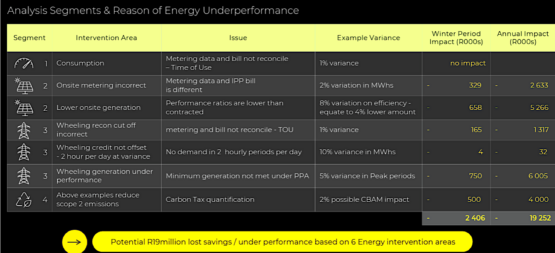
Futter warns that in this complex environment relatively small forecasting errors, contract underperformance, or network disruptions can have significant financial consequences and, in some cases, translate into tens of millions of rand in avoidable cost leakage.
As an example, Futter points to one large power user for whom he did a feasibility study. The client was unaware that his rooftop solar, situated on a shopping mall roof, had underperformed over several years because he did not have metering data. It cost him R10 million rand in forfeited savings.
An example of the potential financial impact of under-performance:
Source: Florion
Another client was managing data from 85 bulk meters over 20 Excel spreadsheets. When Eskom changed its tariff structure, he had to change the time-of-use slots across all 20 spreadsheets, which proved to be a challenge since some of them were not under his control.
ADVERTISEMENT:
CONTINUE READING BELOW
How to manage it all?
So far, there haven’t been any South African solutions designed to provide a single view across this new environment, where multiple energy sources, offtake contracts, pricing structures, regulations and market risks need to be managed as an integrated whole, says Futter.
Together with Michael Udell, a digital strategy, innovation and product development specialist, Futter has now developed a solution, named Florion, that connects fragmented energy data to commercial decision-making, helping businesses improve forecasting, strengthen visibility, and manage cost and risk more effectively in an increasingly dynamic market.
“Florion is the first South African solution designed specifically for this challenge, helping businesses understand exactly what has happened, what is happening now, and what is likely to happen next,” says Futter.
“While traditional energy management systems focus on specific operational functions, Florion takes a broader view of the energy environment,” he adds.
“By bringing together and orchestrating data and intelligence from across the energy value chain, we help businesses make more informed, forward-looking decisions, reduce risk, and unlock opportunities for greater competitiveness and growth.”
Florion already has one mining and beneficiation client and will be focusing on solutions for the 250 large power users with loads of more than 10MW that collectively consume 50% of all energy generated.
“These organisations already have sophisticated metering infrastructure, large energy budgets and increasingly complex energy portfolios involving Eskom supply, self-generation, wheeling arrangements and energy contracts,” says Futter.
#energy #frontier #Managing #data