America’s public-company boardrooms are greying fast.
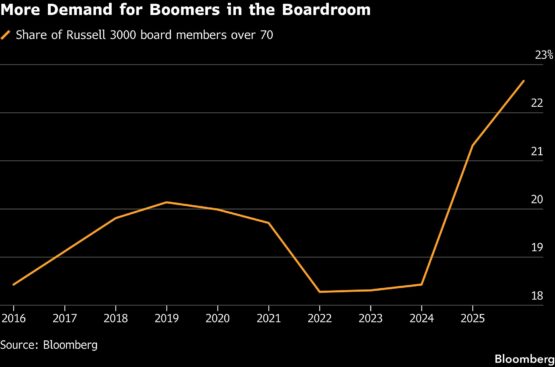
The share of corporate directors over the age of 70 has jumped to 22.7% of all board members at companies in the Russell 3000 index, up from 18.4% in 2023, according to data compiled by Bloomberg.
Far from overstaying their welcome, Boomers in many cases are holding onto their board seats at the behest of companies seeking to ride out macro uncertainty and placate a White House intent on stamping out diversity, equity, and inclusion policies. The thinking goes that older executives who have led companies through more economic ups and downs will be better positioned to deal with today’s shocks, from tariffs to wars to rising inflation, according to corporate governance experts.
Companies “are looking for CEOs with experience in these cycles” to join or stay on their boards, said Rebecca Thornton, who co-leads the North America board advisory practice at executive search firm Spencer Stuart.
ADVERTISEMENT
CONTINUE READING BELOW
Some boards are even opting to change their governance rules to keep directors on longer and choose older replacements. The number of S&P 500 companies with no age limit for directors is up 30% since 2020, according to data from the Conference Board.
The downside
Holding onto older directors for longer could put companies at a disadvantage, especially as artificial intelligence rises up the list of board priorities, according to Anthony Goodman, who leads the board effectiveness practice at executive search firm Korn Ferry.
Many board members over the age of 70 “have not been in the workplace for at least a decade,” Goodman said. “You are asking them to make capital allocation decisions about things like AI that they have never experienced.”
As digital transitions took off in the early 2010s, boards often chose younger directors based on their familiarity with new technology, according to Jane Edison Stevenson, global vice chair of Korn Ferry. And from 2019 through 2022, a period roughly corresponding with a spike in DEI sentiment and the Black Lives Matter movement, the share of public company board members over the age of 70 declined each year, according to Bloomberg data. But a number of large companies have since backed off commitments to use diversity criteria in identifying board candidates.
ADVERTISEMENT:
CONTINUE READING BELOW
As companies continue to pull from the same group of older directors, they run the risk of their personnel pipelines going stale. “If you want somebody that’s been on these boards and has that experience, then by definition you’re not introducing new people,” said Kathy Gersch, chief executive and founder of consulting firm Kotter.
She suggests a simple solution, which is also gaining popularity among those concerned about the age profile of the U.S. Congress and courts: term limits.
“It forces the refresh on a managed basis,” said Gersch, who recommends capping board service between nine and 12 years. “You’re not turning the whole board over at one time, but you’re regularly turning the board over and bringing in fresh perspectives.”
© 2026 Bloomberg
#share #corporate #directors #age #skyrocketing