President Donald Trump said the US would strike Iran again Thursday and sought to crank up pressure on the Islamic Republic to reach a deal by threatening to take control of key energy infrastructure in the country.
“The United States will be hitting Iran (Whose Navy, Air Force, Radar, Anti Aircraft, and all other forms of Defense, together with most of its offensive capability, are GONE!), VERY HARD TONIGHT,” Trump wrote on his social media platform.
Trump, who has expressed increasing frustration by the slow progress in negotiations, raised the possibility of seizing Iran’s energy facilities, including Kharg island, the loading point for around 90% of the country’s crude shipments. Such a move would likely require US ground troops.
“At some point in the not too distant future, we will be taking Kharg Island, and other oil infrastructure points, and assume total control of their Oil and Gas Markets, much like we have with Venezuela,” he wrote.
Putting US servicemembers on the ground in Iran would be deeply unpopular at home, which the president seemed to acknowledge in comments to Fox News just minutes after his post.
“I am not sure America has the appetite for what I would really like to do,” he said of taking Kharg island.
Trump’s mention of critical Iranian energy targets comes as talks between the US and Iran — with Qatar playing an increasingly important role as a mediator — are continuing, with progress made this week, according to people familiar with the diplomacy.
Each side is using the exchanges of fire as a way to try to pressure the other and gain better terms in the negotiations, one of the people said.
ADVERTISEMENT
CONTINUE READING BELOW
Oil prices swung between gains and losses on Thursday, with Brent now unchanged around $93 a barrel, well below its high of over $125 in late April. That’s due to factors such as weak demand in China, though it’s also a sign many energy traders expect Iran and the US to agree a deal in the coming weeks.
A wave of tit-for-tat strikes began last week and has been focused on military targets, signaling that neither side wants to increase hostilities beyond a contained range meant to build pressure.
On Sunday night and into Monday, Israel and Iran launched missiles against each other. The US then blamed Iran for downing a US Apache helicopter near the Hormuz strait. The latter incident, which Iran hasn’t said it was responsible for, triggered Trump’s order of strikes in the past two days.
Iran fired Thursday on US bases in Kuwait, Bahrain and Jordan. Kuwait briefly closed its airspace and Jordan said it intercepted 20 missiles. Bahrain reported one child was injured after shrapnel from missile interceptions fell on its capital, Manama.
Three people were injured in Tehran, the semi-official Iranian Students’ News Agency said, citing the head of the capital’s emergency services.
Iran also said the Strait of Hormuz would be closed to all types of vessels, suggesting it would tighten its grip on a waterway through which only a small number of oil tankers and other vessels have got through since the start of the conflict in late February. The Islamic Revolutionary Guard Corps said it hit two vessels trying to sail through the chokepoint early on Thursday. The incidents had not been confirmed and the US said commercial ships continue to transit through.
Iran’s newly created Persian Gulf Strait Authority said vessels that had already received permission to go through the strait should “be patient and await further guidance.”
The US and Iran have been in indirect negotiations since they started a ceasefire on April 8. Yet they’ve failed to reach an interim deal — to be followed by more complicated discussions about curbing Tehran’s nuclear program — and their confrontations have intensified in the past week.
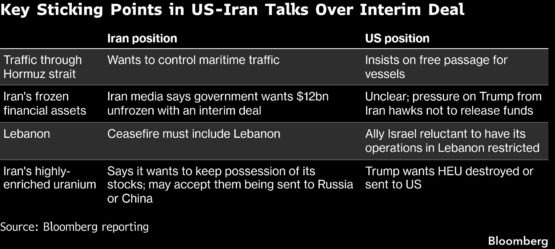
There are several sticking points between the warring sides. Tehran insists the US unfreeze more than $10 billion of Iranian funds held in countries such as Qatar, and Trump is demanding the Islamic Republic relinquishe or destroy its stockpiles of highly enriched uranium. Iran also wants a ceasefire in Lebanon, where Israel is fighting Hezbollah, a key ally of Tehran.
ADVERTISEMENT:
CONTINUE READING BELOW
Overnight, the US targeted Iranian military sites, including air-defense installations, with around 50 Tomahawk missiles. Central Command, which oversees American forces in the Middle East, described them as “self-defense strikes,” in a signal that Trump wants to avoid restarting a full-on war.
Trump said to Fox he has spoken to Iranian officials directly, telling them to stop bombing US assets. He didn’t say who he spoke to in what would be a very rare instance of a US president conversing directly with Iranian authorities.
The president has consistently said he wants to end a war that’s killed thousands of people across the Middle East, sent energy prices surging and is increasingly unpopular with Americans.
Trump doesn’t have much time if he wants to avoid a further jump in prices. Crude will rise to $150 if the strait remains shut by August, according to energy-market consultancy FGE NexantECA. Western governments are drawing down emergency petroleum stockpiles at a record pace to keep a lid on prices.
In recent weeks, some oil producers have found ways to export oil by making so-called dark transits. While conventional vessel-tracking data show little change in shipments, senior shipping executives, Asian oil buyers and satellite imagery suggest traffic through Hormuz is becoming more steady and increasing in volume.
Even so, the passages are still far below the prewar average of about 135 ship transits a day.
Here’s more on the war:
- Qatari negotiators departed Tehran following discussions on the war, AFP reported.
- India summoned a senior US diplomat after a strike on a second Indian-crewed vessel in the Gulf of Oman this week left three sailors dead.
- Another tanker appears to have been hit. It reported that it was in distress and its engine room was on fire on Thursday in waters off Oman.
- Nikki Haley, Trump’s ambassador to the United Nations in his first term, expressed skepticism in an interview with Bloomberg that negotiations would succeed. “Iran was never going to do a deal,” she said.
© 2026 Bloomberg
#Trump #vows #attacks #Iran