Bitcoin’s latest retreat has been so severe, it has pushed more than half its circulating supply into loss-making territory.
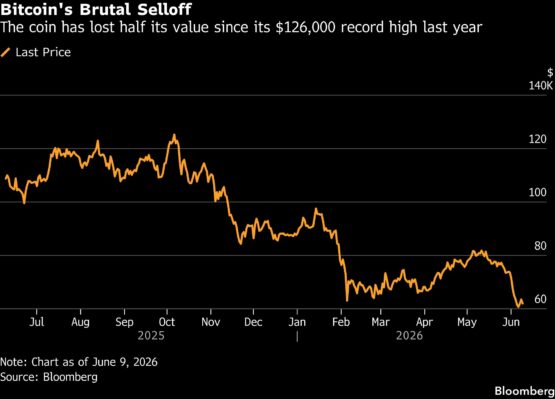
With the coin trading around $62 000 — down some 50% from its record highs — and a fresh break below its 200-week moving average, it is quickly racking up losses for a growing share of its holders. For the first time since late 2022, more than 50% of the coins trading are doing so below their purchase price, according to Vetle Lunde at K33 Research. The figure stood at just 30% a month ago.
It’s the latest sign of stress for a market that’s been mired in a downdraft for months. Bitcoin and numerous other tokens have been selling off since October, with few positive developments able to arrest a decline that last week brought the largest token to its lowest since 2024 and wiped out all gains notched during the crypto-friendly Trump presidency.
Its newest leg lower set off after Bitcoin-treasury firm Strategy announced a sale of a handful of tokens that sent anxiety swirling among traders given the importance the company has held within the crypto ecosystem. Outflows from Bitcoin-focused exchange-traded funds have accelerated, too, and volatility has spiked to a three-month high, K33 said.
For Bitcoin holders — long- and short-term ones — it’s been painful.
ADVERTISEMENT
CONTINUE READING BELOW
“Prices move because of structural positioning, leverage, emotional reactions, and event-driven risk, but the bigger picture is a reflection of persistent market conditions,” said Ophelia Snyder, who was a co-founder of the asset-management firm 21Shares. “And until those underlying conditions change, I think we’re likely to continue seeing more of the same: range-bound markets, periodic volatility, leverage resets, and a lot of investors waiting for the next truly important catalyst.”
The significance extends beyond paper losses. Bitcoin’s most powerful rallies have historically depended on attracting new buyers willing to pay higher prices than the previous wave of investors. When more than half of the supply is underwater, the market begins to carry the weight of millions of disappointed holders who bought into last year’s enthusiasm.
That can become a headwind of its own. Investors sitting on steep losses often use rallies as opportunities to exit positions rather than add to them, creating a source of latent selling pressure. At the same time, a prolonged drawdown risks damaging one of Bitcoin’s most valuable assets: its reputation as a trade that reliably rewards patience. Every month spent far below its highs is another month in which a new generation of investors associates crypto less with extraordinary gains and more with missed opportunities, especially as capital chases faster-moving stories elsewhere in markets like AI chipmakers.
“After 17 years, Bitcoin still has no use case beyond pure speculation,” said JonesTrading Chief Market Strategist Michael O’Rourke.
ADVERTISEMENT:
CONTINUE READING BELOW
On the surface, developments within the crypto space have been looking constructive, belying the angst-filled nature of the market itself. The Trump administration has been receptive toward cryptocurrencies, urging along all manner of regulation to bring the products closer into the mainstream. Traditional financial outlets have been more embracive, too, as the investor base has broadened. And all manner of projects are finally being built on top of crypto rails, a vision that digital-asset proponents have long advocated for.
But the reality on the ground has been much bleaker. A roster of Bitcoin exchange-traded funds trading in the US has seen some $5.5 billion in outflows over the past month, according to data compiled by Bloomberg, further pressuring the underlying price. Meanwhile, total volumes across centralized exchanges last month slumped month-over-month to $4 trillion, marking the second consecutive month for the figure to be at the lowest levels in nearly two years, according to a report from Cantor’s digital assets research team.
Still, Lunde at K33 might have found a silver lining amid the bad-news deluge. Historically, half of Bitcoin trading “underwater” has only been seen near major bear-market bottoms “as selling pressure from profitable holders becomes increasingly exhausted.” In the past, the coin has tended to bottom within weeks of crossing that level, though it has also been known to suffer through an additional “final leg lower,” Lunde wrote in a note.
“While not a guarantee, the setup suggests downside may be limited relative to the potential upside over the coming year, strengthening the case for a contrarian bullish bias,” he said.
© 2026 Bloomberg
#Bitcoin #selloff #leaves #supply #trading #loss