Just over nine months ago, Siyanda Mthokozisi Mvelase was brutally killed in Maponya Mall. His only crime? He was an Uber driver.
He was operating in the precinct of Maponya Mall, where conventional taxi operators have formed the view that the territory is theirs and no one else should be able to operate there.
Mvelase is not the only victim of the war between taxi drivers and e-hailing drivers; he is one of many in a longstanding crisis that exists at the epicentre of dislocation, discontent, governance paralysis and criminality.
Read: Ride-hailing contributes to income stability for SA gig workers
The source of the fracas is the longstanding tension around opportunities, dependency and entitlement.
For a long time, the taxi industry has formed a central part of the commuter and mobility model in South Africa.
As a country bedevilled by spatial planning reminiscent of the desire to exclude rather than incorporate, taxis have enabled many citizens to access economic opportunities that would otherwise be more difficult to access.
How South Africans get around
Data from the General Household Survey published by Statistics South Africa indicates that less than a quarter of workers walk to work, while 24% rely on taxis and just 3.6% rely on buses to get to work.
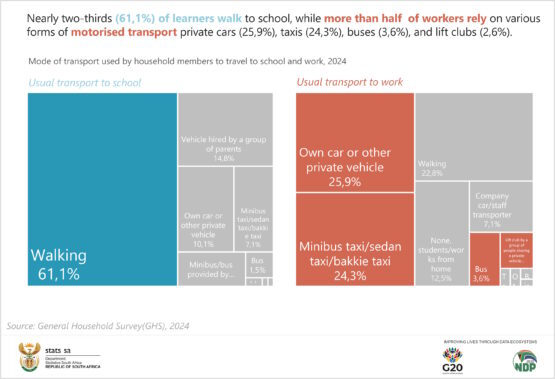
Source: Stats SA (General Household Survey 2024)
ADVERTISEMENT
CONTINUE READING BELOW
Buses – which serve as the other bulwark of the transport sector – have natural limitations that limit their ability to cover the breadth of the country.
Read:
‘Landmark victory’ for public transport safety in SA – Intercape
The sinister forces behind the arson attacks on Putco buses
Comparatively, the barriers to access are lower in the taxi industry than in the bus service industry. This results in greater competition and intensity in the taxi industry and, since time immemorial, turf wars have been an endemic feature of the industry.
Turf wars
Disputes over route access and the desire to secure a greater share of the market have conspired to make the industry difficult and dangerous to operate in.
The role of regulators and public officials in managing the operational landscape through permit systems or other regulatory instruments seemed to falter on many occasions.
The advent of e-hailing over the past decade resulted in a new dimension of contestation where taxi industry stakeholders feel sidelined and not protected from the ‘perils of encroachment’ by mobile-enabled e-hailers.
In essence, the industry has shifted:
- From taxis having distinguished themselves from buses by covering the major part of the first and last mile; to
- E-hailers distinguishing themselves from the taxi industry by leaving no gap between the commuter location and destination and also being unshackled by the time horizons that affect most taxi operators.
The attraction to commuters was therefore inevitable and even the price premium associated with e-hailing became the accepted compromise.
The taxi industry’s response – as one could have predicted – was premised on collective and cumulative frustration where criminal instruments were not far from the arsenal of the actions aimed at deterring consumers from using e-hailing services.
Read: No one seems willing to take on taxi industry’s anti-competitive behaviour
ADVERTISEMENT:
CONTINUE READING BELOW
The risk to both commuter and driver escalated, and some prime pick-up spots at train stations, shopping centres and similar high-density areas became zones of hostility where e-hailing drivers feared to tread out of fear of victimisation.
Incidences of violence and brutality flared – and through it all law enforcement and industry regulation lagged behind.
This inability to decisively address the scourge of criminality and also address the regulatory gaps means the country is always one heartbeat away from another escalation in violence aimed at e-hailing drivers.
Stalled solutions
Government’s mission towards addressing the issues of publicly-accessible transport options has not been aided by its own inability to ensure the stability and viability of the rail sector.
The long journey towards restoring entities like the Passenger Rail Agency of South Africa (Prasa) and Metrorail to their optimum capacity remains ongoing and far too slow for the type of crisis we face.
Read: Cape Town pushes to be SA’s ‘first metro in charge of passenger rail’
In recent months, the government has acknowledged that its investment into the integration of public transport resources – through services like Rea Vaya – has failed to achieve its stated objectives and will actually be phased out.
In its place, the hope is that something more responsive to the issues affecting both private and state providers of transport options for the public will be cohesively addressed.
In explaining the rationale for winding down the Public Transport Network Grant that was rolled out across 11 municipalities, the Department of Transport cites multiple collective and cumulative failures and capacity limitations that imperilled the investment.
ADVERTISEMENT:
CONTINUE READING BELOW
Read: Eastern Cape town’s R7.6 million taxi rank left unused for years
Some of the challenges – municipal incapacity, poor governance and compliance, fractious industry integration, and bad financial modelling – are issues that are endemic to many government programmes that are meant to be managed at municipal level.
The capacitation question
The problem of conceptualising a replacement model – the government is proposing a transport-based fund where cities will be invited to join a new regime characterised by revised funding mechanisms, true spatial integration and flexible models – is that it all depends heavily on solving the capacitation question.
Read: The start of a new era of transport, logistics and mobility in SA? [Jul 2024]
The stark reality of the national infrastructure and technical skills profile is that places where resources are most needed – like non-metropolitan municipalities – often struggle to attract the talent required to meet the defined dimensions of capacitation.
If this is not resolved before the first rands towards the new regime are spent, the R80 billion the finance minister says was spent on the failed attempt at integration will be a fraction what ultimately gets lost in rands spent and frustrated commuters.
More crucially, having learnt from the past how frictions in integration efforts fuel fears of displacement and lead to violence and criminality, making sure the law enforcement is adequately capacitated for the inevitable conflicts must be implemented with the type of vigour that matches the scale of the crisis afflicting the road transport sector.
Getting this right will be one element of paying homage to the lost lives of Siyanda Mvelase and many others who have fallen victim to the difficulties afflicting the industry.
#Public #transport #integration #disaster