As the Trump administration tones down its public stance on Taiwan, key US allies Japan and the Philippines are becoming more vocal in challenging Chinese President Xi Jinping on his most sensitive issue.
The leaders of Japan and the Philippines have suggested in recent months their nations would likely be drawn into any fight over Taiwan, remarks that irked Beijing. The two have also moved to deepen military ties, agreeing last week to elevate their relationship and open a series of defense talks.
That fast-deepening alignment contrasts with Washington’s emphasis on a more ‘quiet’ approach toward Taiwan. At a Beijing summit last month, President Donald Trump backed Xi’s vision of “strategic stability” in bilateral ties and echoed some of his talking points on the self-ruled democracy.
Then, at a security forum in Singapore last weekend, Defense Secretary Pete Hegseth became the first Pentagon chief in over a decade to avoid mentioning Taiwan in his speech.
Read:
Taiwan overtakes India as world’s fifth-largest stock market
Winners and losers from Trump and Xi’s two-day Beijing summit
Japan and the Philippines have “hit fast-forward on building a wider network of partners”, said Raymond Powell, a retired US Air Force colonel who founded the SeaLight Foundation, a maritime transparency initiative.
“If Beijing is going to weaponize markets and maritime spaces, its neighbours have to respond by weaving a denser, more resilient network to complicate its strategic calculus.”
Although Hegseth said US policy toward Taiwan was unchanged and that the only shift was in tone, it remains unclear if Trump will proceed with a stalled $14 billion arms package for Taiwan. Trump has called the weapons deal a “bargaining chip”, breaking with precedent.
On Wednesday, Secretary of State Macro Rubio said the sale is not being withheld but “just under review” during a hearing of the House Committee on Foreign Affairs.
SECRETARY RUBIO: “5 months ago, we did the single largest sale to Taiwan in history at $11 billion.” pic.twitter.com/r3LFksEbIx
ADVERTISEMENT
CONTINUE READING BELOW
— Department of State (@StateDept) June 3, 2026
As the fate of that deal remains unresolved, leaders in Tokyo and Manila are testing how far the two nations can go in cooperating on defense matters without provoking an overwhelming response from Beijing.
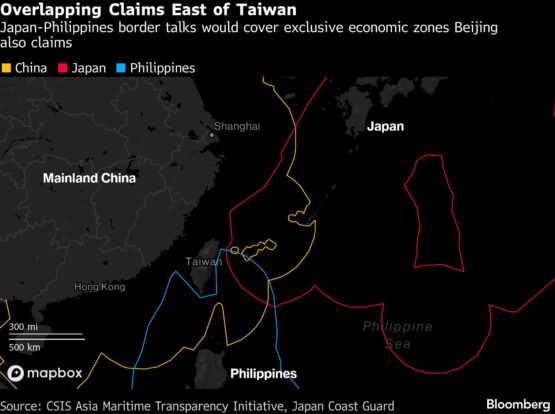
Last week’s agreement opened talks on a military information-sharing pact and on resolving their maritime borders, building on earlier deals to ease joint exercises and share supplies.
Those moves followed remarks last month by Philippine President Ferdinand Marcos Jr. that his nation would likely be drawn into any Taiwan conflict given its proximity to the island, echoing similar comments in November by Japanese Prime Minister Sanae Takaichi.
China has responded with indignation in both cases. Beijing claims the self-ruled island as its territory, a stance Taipei rejects.
ADVERTISEMENT:
CONTINUE READING BELOW
China’s response to Tokyo has been particularly harsh. After Takaichi suggested last year that a Taiwan Strait crisis could amount to a “survival-threatening situation”, Beijing rolled out punitive economic and political measures and froze official exchanges, demanding that she retracts the comments.
The Japan-Philippine border talks especially angered China, since negotiations would cover waters east of Taiwan where Beijing also claims economic and continental-shelf rights.
On Monday, China sent Coast Guard vessels to patrol Taiwan’s east in a show of de-facto “jurisdiction”, warning of “unprecedented” countermeasures if the talks proceed.
State broadcaster CCTV accused the two nations of “colluding” to pursue their own ends. In Beijing’s telling, Japan is leveraging the Philippines to contain China, while Manila is angling for greater security commitments, military aid and more bargaining chips in the contested South China Sea.
Japan and the Philippines have cast the talks differently. Marcos said the steps were meant to uphold a rules-based maritime order and build trust, while Takaichi framed deeper ties as the work of like-minded nations to meet unspecified challenges in the changing global environment.
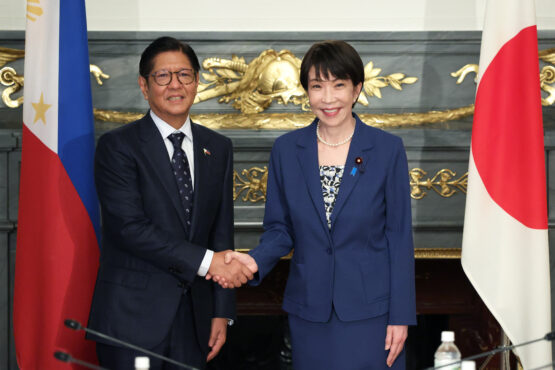
Sanae Takaichi and Ferdinand Marcos Jr. in Tokyo on 28 May. Image: Kiyoshi Ota/Bloomberg
China has also bristled at Japan’s deepening ties with NATO. A Foreign Ministry spokesperson on Monday decried Japan’s plan to send four Self-Defense Forces personnel to a NATO training headquarters in Germany – the first time it has done so – as proof the nation was pursuing “remilitarisation at full throttle”.
Japan and the Philippines have already signed deals to streamline logistics and ease joint exercises, plus a separate accord to make military supplies more interoperable. Japan now holds information-sharing agreements with the US, South Korea, India and NATO, among others.
These efforts also underscore how US allies are navigating Trump’s ‘America First’ approach, which increasingly leaves them to fend for themselves.
Read: NATO bids gain support, China in focus at summit
ADVERTISEMENT:
CONTINUE READING BELOW
Yoichiro Sato, a professor of international relations at Ritsumeikan Asia Pacific University, said Japan is “sandwiched” between China’s accusations and US demands for greater defense spending, pressures Trump has applied to allies in both Europe and Asia.
“As long as the US holds a credible ‘stick’, Japan does not have to hear loud anti-China talk from the US. The problem is the decline in the relative US power to project forces in East Asia,” he said. “Filling the void left by the insufficient US commitment is the primary reason.”
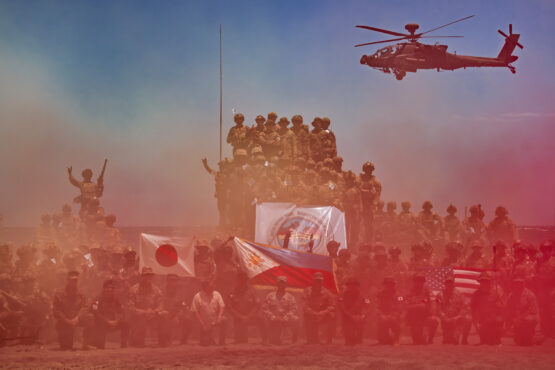
US, Japanese and Philippine troops pose for pictures during the annual Balikatan joint military drills on 4 May.
The sentiment runs deep in Manila too. Rommel Ong, a retired rear admiral in the Philippine Navy, said the goal for Filipinos is “Trump-proofing our defense posture against shocks from US policies, diminished presence in East Asia and global commitments”.
The border talks, Ong added, would “provide a structured template for joint patrols between the two states”, affecting China’s intent to control the strategic Bashi Channel between Taiwan and the Philippines.
Should such activities become routine, the odds of accidental flare-ups are likely to rise. Analysts warn that more Chinese pressure, absent any restraint from Beijing or firmer commitment from Washington, risks deepening a classic security dilemma in which each side’s defensive moves provoke the other.
For now, Beijing appears wary of overreacting.
“Japan’s efforts to build closer security and military ties with regional countries and NATO have been ongoing for a few years,” said Zhu Feng of Nanjing University’s School of International Studies, calling it a natural result of a shifting balance of power. Closer cooperation between Japan and the Philippines, he warned, “will be a test for China’s strategic patience”.
© 2026 Bloomberg
#Japan #Philippines #test #Taiwan #Trump #treads #softly