Recruitment companies, facing the threat of artificial intelligence tools replacing human labour and customers embracing AI-assisted applicant screening, are adapting by honing in on niche, in-demand jobs in the AI economy.
“While much of the initial AI hype focused on displacement, the reality is that the long tail of job growth is becoming much longer,” Sander van’t Noordende, chief executive officer of temporary employment company Randstad NV, said in an interview.
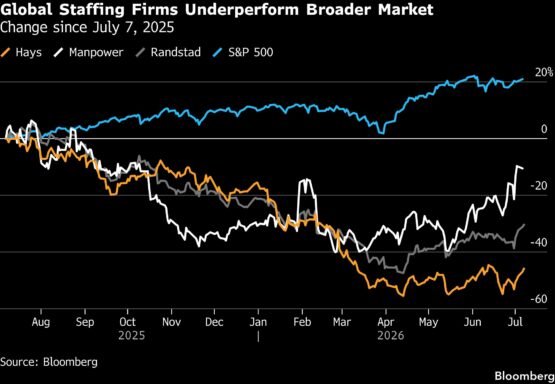
The industry’s transformation comes as companies’ hiring plans continue to be held back by high oil prices, tariffs, and weak consumer confidence. Firms are slowing recruitment and taking more time to determine which skills require human workers and which can be augmented by AI, said Noah Yosif, chief economist at the American Staffing Association.
Demand for roles that support AI integration — titles like AI trainer or process automation specialist — is soaring, with vacancy rates above 25% for some of the jobs, Randstad data shows.
Other sought-after roles include data scientists, database architects, and cybersecurity experts, jobs that have been around for decades, but now are in even higher demand when AI skills are attached to them, ManpowerGroup Chief Growth Officer Valerie Beaulieu-James said in an interview.
Cybersecurity is a “critical area of investment,” Hays Plc’s UK and Ireland CEO Tom Way said, as companies deal with the risks associated with rapid digital transformation.
ADVERTISEMENT
CONTINUE READING BELOW
Construction projects for AI plants are also supporting skilled trades, with demand for electricians, plumbers, and builders growing three times faster than professional roles, Noordende said. “You cannot build the cloud or run data centers without moving dirt and laying cable,” he added.
Research from Robert Walters Plc shows that one in two AI roles in the UK and the US could go unfilled by 2028. That’s about 160 000 unfilled positions in the UK and shortage of more than 800 000 in the US.
AI has created an “unbalanced” hiring landscape, with demand for AI-related positions pulling the job market up while other careers are under pressure, ManpowerGroup’s Beaulieu-James said. AI-related job postings in the US rose 95% in the first half of 2026 from a year earlier, while overall job postings fell 16%, according to market intelligence firm TalentNeuron data cited by ManpowerGroup.
Strategic shift
To move with the AI boom, recruiters are rethinking their entire strategy.
Hays and peers “are increasingly building expertise around specialist skill communities rather than broad tech categories,” Way said.
Robert Walters has moved further away from the junior end of the market, according to CEO Toby Fowlston, as those roles tend to be more easily replaceable. It has also refocused geographically, shutting down operations in Brazil and Canada, and investing heavily in Japan.
ADVERTISEMENT:
CONTINUE READING BELOW
“You’ve got huge technology capability and demand in Japan and you’ve got obviously a huge demographic challenge,” he said in an interview. “So the ability to find international talent that will move, particularly within that technology sector, is going to be critical. Clients want to be working with organisations that are able to provide that supply chain.”
While they trim their geographic footprint and move toward a “narrower pool of high-value, in-demand skills,” as Hays’ Way put it, recruiters are broadening the services they provide.
Robert Walters has focused on upskilling employees whose tasks can be automated. “We’ve really shifted in the last three years from being very singularly a recruitment business to really now thinking about how we can help our clients orchestrate their talent strategy,” Fowlston said.
Emphasizing human discernment and relationship building are also key. AI ??has made it harder for employers to “distinguish among candidates and authenticate their qualifications,” making recruiters more valuable, Robert Half Inc. CEO Keith Waddell said on the company’s latest earnings call.
Though they still face depressed share prices and tepid earnings, staffing companies have reported stabilizing and even improving conditions in some key markets.
SThree Plc CEO Timo Lehne was optimistic in connection with a trading update last month, saying soaring demand for python developers and cybersecurity experts is providing a much-needed boost.
© 2026 Bloomberg
#Recruiters #shift #focus #specialised #jobs #stay #relevant