Advances in artificial intelligence are levelling the field for fund managers, making it easier for boutique firms to compete with big macro and bond investors.
From digesting speeches in multiple languages and crunching global inflation numbers, to tracking company filings and the tone of investment committee discussions, AI is picking up much of the work once carried out by teams of analysts, according to five executives who have recently set up their own shops.
“Technology has changed the economics of building an investment firm,” said Dharmesh Maniyar, a machine-learning PhD who founded his second fund, MQT Asset Management, late last year. “AI allows a focused boutique organisation like us to build powerful capabilities much earlier in our lifespan.”
Macro funds try to anticipate the impact of global economic and political shifts across markets rather than investing in discrete asset classes or sectors. Their strategies rely heavily on analysing huge volumes of data and text, work ideally suited to the large language models that have come a long way since Maniyar’s first firm folded.
Read:
These AI gurus are charging Wall Street banks $25 000 a day
Bank CEOs’ AI obsession collides with warning from watchdogs
“Macro markets have become more complex, more policy sensitive and faster moving, while the tools available to investment managers have improved dramatically,” said Maniyar, who previously managed money at Brevan Howard Asset Management and Tudor Investment Corp.
Morgan Stanley Backs Tudor Alum Dharmesh Maniyar’s Hedge Fund
Five-person hedge fund Palinuro Capital, launched last year by Alfonso Peccatiello, aims to compete with desks of 20-50 people. It uses LLMs to parse speeches by central bankers from Hungary to South Korea, work that previously would have required regional specialists. “It’s effectively like having a set of unbiased analysts for a portion of the cost,” Peccatiello said.
ADVERTISEMENT
CONTINUE READING BELOW
Small bond-focused funds like Osmosis NL face a similar data challenge. Research that once took weeks is completed in days, allowing the young firm to scale up rapidly with a team of just 15, according to Victor Verberk, chief executive and chief investment officer.
“A smaller company like Osmosis can now cover the entire universe,” Verberk said, adding that AI has allowed him to cut his three-year hiring plan by 25%. “The machine is never ill, it’s never on holiday, it’s always there.”
Increased Competition
AI is already transforming white-collar work across industries such as software, marketing, consulting and accounting. Banks are creating fewer entry-level roles and wealth managers are increasingly focused on their richest clients while bots take care of the rest.
In fund management, which has been using machine learning and algorithmic trading for decades, the fast-evolving technology is being widely embraced. A survey of over 400 fixed-income investors by Barclays Plc in May found that half of long-only managers and the majority of hedge funds use AI every day, largely for research.
“This points to a market that is becoming more competitive, more democratised and faster?paced,” said Zornitsa Todorova, head of thematic FICC research at Barclays.
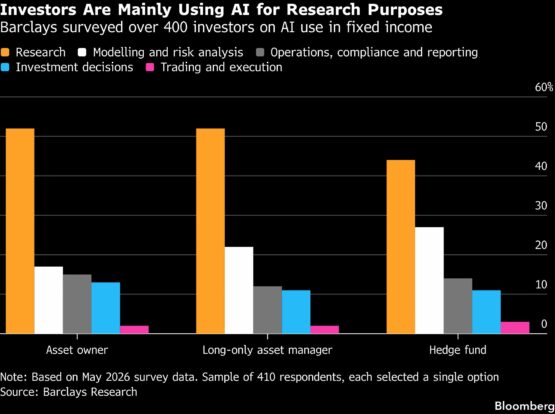
In addition to transforming research, the new tools are helping with risk management and modelling. Palinuro leaned on an AI assistant during this year’s oil price shock to screen dollar and commodity options for the cheapest way to hedge, said Peccatiello.
At Alpha Curve Investments, an unconstrained bond fund launched in 2025 with just four people, Philippe Gougenheim and Pierre Ahlsell de Toulza asked Anthropic PBC’s Claude to estimate consumer price trends based on data from the US, Europe, Australia, Brazil and Canada. Then they switched 70% of their £100 million ($132 million) portfolio into short-dated inflation-linked bonds.
ADVERTISEMENT:
CONTINUE READING BELOW
Eric Lonergan, who oversees more than $1 billion of assets as head of Calibrate Management Ltd’s new Discretionary Macro Fund, said he uses AI to screen 100 global assets into 10 trade ideas, replacing work that “legions of analysts” would have done in the past.
Rapid change
Unlike the bigger platforms, upstarts tend not to have legacy systems that complicate rollouts, allowing faster adoption. Verberk, who spent 16 years at Robeco running fixed income strategies, says it’s easier and cheaper for small firms to integrate new technology. His boutique uses just two core platforms: Microsoft Azure and Bloomberg.
“Given the speed with which AI is changing, you need to be highly creative and experimental,” said Lonergan, a former portfolio manager at Eisler Capital and M&G Investments.
Still, bigger firms with deeper pockets are likely to continue to have an edge, according to Ben Conway, chief investment officer at Hawksmoor Investment Management Ltd. “That’s something we’re taking into consideration when selecting funds,” he said.
Maniyar acknowledges the advantages larger firms still have in terms of capital resources, distribution and breadth of coverage but says technology has made the “playing field more interesting.”
“The edge is how you integrate data research, AI portfolio construction, execution and risk into a coherent investment process,” he said. “Technology has definitely democratised the infrastructure, but not skill.”
© 2026 Bloomberg
#hedge #funds #bots #rival #industry #giant