Summers used to be quite different for Vera Kalogera. As a child growing up in Athens, she would escape the urban sprawl with her parents for an island. She would meet other families doing the same, the annual break by the Aegean or Ionian sea a near ubiquitous part of Greek family life.
Now a 35-year-old mother, Kalogera can’t afford such a vacation. Even when planning shorter trips, Greece’s quintessential holiday spots are out of reach.
“The situation is worse than in previous years when it comes to groceries, energy, rents,” said Kalogera, a teacher who lives in a district among the wealthier northern suburbs of the Greek capital. “We’ve really cut down on all our discretionary spending.”
Read: Greece turned its economy around – but it had one advantage SA lacks
Greece’s rehabilitation from its economic crisis over the past decade or so has been lauded by euro region peers and investors alike. But behind the new era of healthy metrics lies a decline in living standards that’s pricing even relatively affluent Greeks out of benefiting from that recovery.
The cost of living is weighing on populations across Europe, compounded by the recent spike in energy and food prices because of war in the Middle East. Few countries, though, stand out as much as Greece when it comes to the gap between performance of the economy and the reality for households.
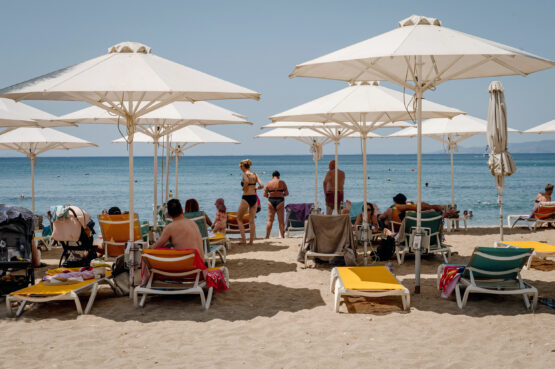
Visitors at Edem beach near Athens. It’s one of the most accessible summer spots for people living in the Greek capital. Image: Hilary Swift/Bloomberg
Greece is growing faster than many European peers, its budget is in surplus and it’s expected to no longer be the continent’s most indebted nation by next year.
Inflation, meanwhile, is among the highest in the euro region, while the average annual salary of about €18 000 ($20 850) is at less than half that of the European Union.
Read: Greece tries first 30-year debt sale since 2008 financial crisis
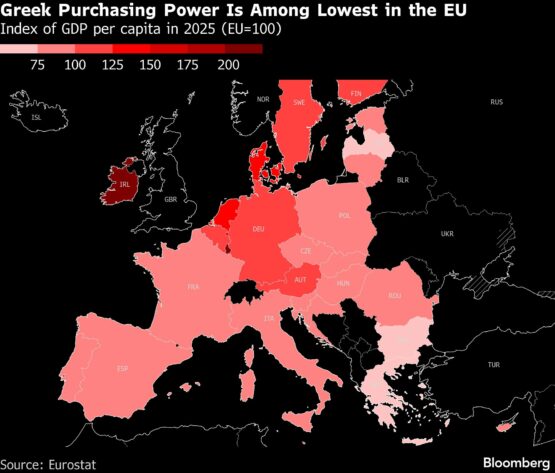
Together with Bulgaria, Greece places bottom in the EU for per-capita gross domestic product and purchasing power. The country also has the largest proportion of people at risk of poverty or economic marginalisation after its northern neighbour.
With an election due by next summer that polls suggest might not produce a clear outcome, Prime Minister Kyriakos Mitsotakis has identified addressing the mismatched metrics as a top priority for his administration.
ADVERTISEMENT
CONTINUE READING BELOW
‘How much does it cost?’
The government has already implemented broad-ranging tax cuts and, more recently, several packages of measures to curb energy and grocery prices following the start of the war in Iran.
Still, only 7% of respondents in a poll broadcast on Greece’s Alpha TV on 16 June said their economic situation had improved last year.
Economic growth, currently running at 2% a year, must have an impact on people’s day-to-day lives, Mitsotakis said this month. “The improvement in macroeconomic figures must translate into even more tangible benefit for all,” he said.
Last week, the government launched a website and app called “How much does it cost?” where people can compare prices daily for 8 700 products such as foods and baby care.
Read: Greece offers pension savings, tax increases to keep euro
While the data is still a work in progress, Mitsotakis said Greek consumers now have another ‘weapon’ in the battle against the cost of living.
The app shows that many products are more expensive than in wealthier European countries, while others are cheaper.
The lowest price for a popular men’s roll-on deodorant, for example, was €2.71, almost a euro more expensive than for the same one in the UK, though similar to the typical price in Germany. What’s also notable is that some local products, such as yogurt, have a higher price in a Greek supermarket.
A combination of pandemic-induced supply chain disruptions and shocks from conflicts in Ukraine and the Middle East have pushed up prices everywhere. In Greece, as in other European countries, that pain is also being exacerbated by a housing shortage.
Greeks spent 35.5% of their available household income on housing costs on average in 2024, based on the latest data available. In almost a third of households that figure exceeded 40%, more than three times the EU average.
Part of the issue is that there was little or no construction or investment in real estate after the onslaught of Greece’s economic crisis in 2010, according to Nikos Vettas, director general of the Foundation for Economic and Industrial Research, a think tank in Athens that studies the Greek economy. That’s only changed in the past five years.
ADVERTISEMENT:
CONTINUE READING BELOW
“This implies a supply lag that is becoming even more intense because the supply has not adapted to population changes,” said Vettas.
“There is no overall lack of houses in the country, but there is a lack of houses in certain areas and with the appropriate characteristics and size.”
In Athens, Kalogera is the sort of voter Mitsotakis’s centre-right New Democracy party covets. She recently gave birth to her first child and decided with her husband to move to a bigger house. They were lucky because they could afford it, but their monthly budget was still stretched, she said.
“We had a very hard time finding a normal house for under €1 000,” she said. That would be out of reach for many people. The minimum wage in Greece has increased by more than 40% since 2019, though is still €920 a month.
Read: Euro zone backs 1bn euro payout for Greece

Mitsotakis voting during parliamentary elections in June 2023. Greece’s prime minister faces an election by next June. The fragmented political landscape suggests it might be tricky to form a government. Image: Konstantinos Tsakalidis/Bloomberg
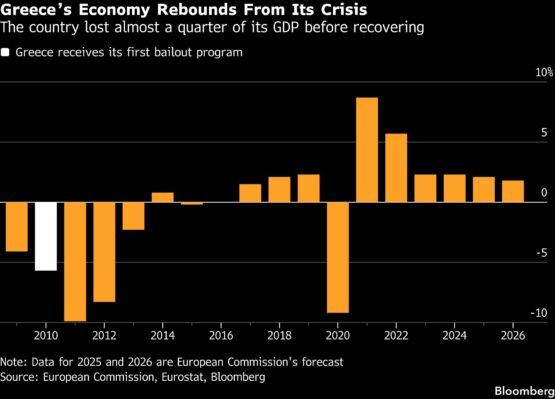
Greece’s economic meltdown claimed almost a quarter of its GDP and upended a way of life for a nation that had for years spent beyond its means. Putting the country’s finances in order and maintaining fiscal discipline has not come without sacrifices.
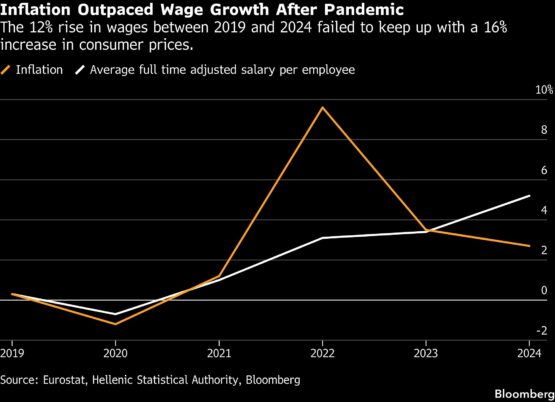
Wages adjusted for inflation today are still well below their 2009 levels.
While household income has increased because of job creation and a 12% rise in wages between 2019 and 2024, consumer prices have gone up more than 16% over the same period.
Read: Greece eyes new reforms
“Increases in prices, including for housing, food and energy have put pressure on segments of the population and they do not see how this pressure will be alleviated in the foreseeable future,” said Vettas.
ADVERTISEMENT:
CONTINUE READING BELOW
Hidden legacy: Tax evasion
That said, data on spending paints a more nuanced picture and may reflect another legacy of Greece’s crisis the government is trying to address: tax evasion.
Greeks spend more than citizens of six of the 27 EU countries, suggesting that there’s money elsewhere. Bank of Greece Governor Yannis Stournaras said evasion accounted for 20-21% of Greece’s GDP compared with 15-17% in the rest of Europe.
Then there’s the issue of how quickly businesses are pushing up prices, according to lawyer Dionisis Alevromageiras.
The 44-year-old runs his own practice and is also struggling to maintain the lifestyle he had, cutting his spending on things like entertainment and clothing.
Read: EU executive says new corporate tax would target below 0.2% of turnover
“The real problem is that there are no substantial audits in the market and prices are constantly going up,” said Alevromageiras. “You need to have auditors on the road making strict checks on businesses.”
The price increases have been compounded by the impact of a vital Greek industry. Tourism accounts for a fifth of GDP and revenue has consistently hit records. That’s put further upward pressure on rents and prices for goods and services, especially on Greek islands.
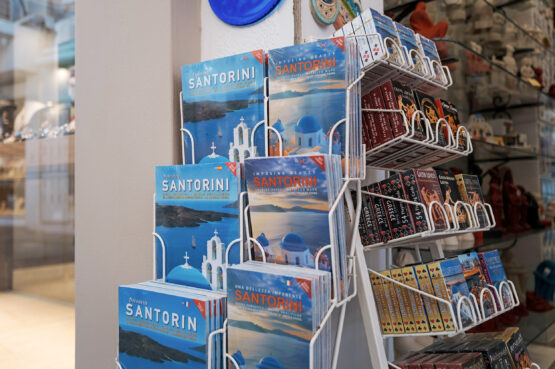
Tourist guidebooks for sale at a souvenir store in Fira on Santorini. The island is one of the most popular for foreign tourists and increasingly out of reach for many Greeks. Image: Jose Sarmento Matos/Bloomberg
For Kalogera, that underscores a change in the social contract many Europeans are experiencing – that her generation would live better than their parents, and her child would live better than her and her husband.
Going on vacation like she did as a child is a luxury that’s now out of the question. She remembers one summer heading to the Greek island of Samos in the Aegean just off the Turkish coast, and then coming home, changing bags and leaving for Zakynthos in the Ionian.
“I remember staying in hotels that had two or three swimming pools and we were swimming in the sea in the morning and in the pool in the afternoon,” she said. “We were eating three meals a day outside. Now you will choose to go out once.”
© 2026 Bloomberg
#Greeks #priced #summer #economic #recovery