US President Donald Trump formally agreed an interim peace deal with Iran, shifting focus to the planned reopening of the Strait of Hormuz and a complex 60-day negotiating period over Tehran’s nuclear program.
Trump signed the so-called memorandum of understanding at the Palace of Versailles near Paris on Wednesday evening, at the end of a Group of Seven summit. He was flanked by world and business leaders, including French President Emmanuel Macron and Blackstone Chief Executive Officer Steve Schwarzman, who applauded as he did so.
“Oil down,” Trump immediately said, emphasizing why he has been so keen to end a war with Iran he started alongside Israel at the end of February. The conflict and Iran’s closure of the critical waterway caused energy prices to soar, and led to chaos across the Middle East.
Trump said further military conflict “could have caused an international depression.”
Those concerns led him to accept an agreement many Iran hawks in the US, as well as Israel, say concedes far too much to the Islamic Republic in terms of sanctions relief and potentially unfreezing tens of billions of dollars of funds. Many say it looks no better than the Obama administration’s 2015 nuclear deal that the US leader calls the “worst deal ever.”
Read:
Trump poised to roll out new tariffs
Gold jumps as peace deal optimism counters hawkish Fed
“History teaches us giving billions of dollars to theocratic lunatics who want to murder us is not a good idea,” said Senator Ted Cruz, a Texas Republican who is normally supportive of Trump’s policies.
ADVERTISEMENT
CONTINUE READING BELOW
While ships weren’t moving en masse through the Strait of Hormuz as of Thursday morning, some appeared to sail through. Three Saudi Arabian supertankers that had been stuck inside the Persian Gulf were recorded as being in the Gulf of Oman, on the other side of the chokepoint. That represents the first large volumes, around 6 million barrels, of Saudi oil to cross the strait since the war began more than three months ago.
Many shipping and oil executives have said they need more clarity, including on whether the strait is clear of mines and whether they need to seek any kind of permission from Iran before sailing through.
There’s also confusion over whether Iran will allow ships free passage. Iranian media has said that might only happen for two months, before Tehran starts charging navigation fees. The US, Europe and Gulf Arab states have balked at the idea of Iran charging a toll for what’s widely considered international waters.
Oil fell further on Thursday, with Brent dropping 1.9% to $78.10 a barrel. It’s down from close to $95 since Trump said late last week that a deal was imminent.
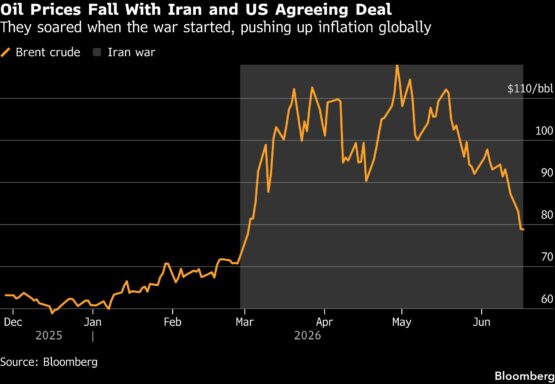
Still, oil remains roughly 30% higher for the year, with energy traders saying it will take months, if not longer, for volumes of oil and liquefied natural gas going through Hormuz to return to normal.
US Vice President JD Vance and Iranian Parliament Speaker Mohammad Bagher Ghalibaf, Iran’s lead negotiator, are scheduled to meet in Switzerland on Friday for a ceremony to mark the signing and start a further round of negotiations to permanently end the war.
The MOU extends a US-Iran ceasefire that began in April by 60 days. During that time, the sides will try to agree restrictions on Tehran’s nuclear program and how to dilute or destroy its stocks of highly enriched uranium. Many nuclear experts say 60 days is too little to negotiate something so complex and technical, and the MOU says the timeframe can be extended.
ADVERTISEMENT:
CONTINUE READING BELOW
The 2015 nuclear deal, which Trump abandoned during his first term, took about two years to finalize.
Israel and the US said the conflict was necessary to prevent Iran acquiring atomic weapons. The Islamic Republic has always denied wanting to do that, though it has raised the suspicions of many governments by enriching uranium far beyond the levels needed for nuclear power plants.
Read:
US, Iran prepare for deal signing
Iranian peace: Now what for our investments?
While Iran’s economy has been battered by the war and some of its most senior leaders killed, its ruling regime remains entrenched. The Iranian military proved able to inflict plenty of damage on the US and allies such as the United Arab Emirates by firing thousands of drones and missiles across the region.
Iran’s closure of the Strait of Hormuz by firing on several ships weakened Trump’s position. As gasoline prices jumped in the US, the war became more and more unpopular among Americans and caused the polling numbers of Trump and his Republican Party to drop ahead of midterm elections in November.
Trump faced pressure, too, from European allies and Gulf states such as Qatar, the UAE and Saudi Arabia to strike a deal with Iran.
Iran will be allowed to restart oil exports immediately under the MOU, with the US granting sanctions waivers. Tehran will also potentially benefit from a $300 billion rehabilitation fund that the US and regional allies are meant to set up. The US has said it won’t provide any money but that other countries are free to.
ADVERTISEMENT:
CONTINUE READING BELOW
The document says the US could unfreeze Iranian funds held in various countries, albeit only if Tehran meets certain criteria.
The upcoming negotiations will likely be tense as Trump comes under increasing pressure from Republicans who say he should “finish the job” with the Islamic Republic, an adversary of the US since its birth with the 1979 Iranian revolution.
“Iran is on its back heel right now, weaker than it’s ever been before,” Mike Pence, Trump’s first term vice president, told Bloomberg Government. “My concerns about the MOU, now that we’ve seen it, have to do with the fact that there’s no mention of verifiably dismantling the nuclear weapons program.”
Trump has claimed for years that former President Barack Obama’s 2015 deal amounted to a massive financial giveaway to Tehran. Trump scrapped it in 2018, ramping up sanctions on Iran and promising something far better.
As more details emerged about the scope of the memorandum, some Republican lawmakers suggested the war wasn’t worth it.
“This is the worst foreign policy blunder in decades,” Senator Bill Cassidy of Louisiana wrote on social media.
© 2026 Bloomberg
#Trump #signs #Iran #deal #Moneyweb