When markets – especially equity markets – are choppy, many investors tend to get nervous. During these periods of volatility, they may exit some investments in the hope of timing their re-entry at a less ‘nervy’ point in time.
Speaking at a recent ‘The Times’ event hosted by the investment manager, Maboa said: “The most common reason for this difference is because investors are often trying to time re-entry and exit from the market.
“We understand why you want to do this – you want to protect yourself when you feel that periods are uncertain – but [it] often brings more risk into the portfolio than what it brings good.”
To illustrate the point, he cites the return from a R100 000 investment in its flagship Allan Gray Balanced Fund in 2001.
ADVERTISEMENT
CONTINUE READING BELOW
The fund had assets of around R260 billion at the end of April, making it – by far – the largest unit trust in the country. By the end of 2025, this R100 000 investment would’ve been worth R2.8 million – an average return of 14% per year.
Read/listen:
But Maboa says that if the same investor had missed just two of the fund’s best months (in terms of returns) over the last 25 years, what would’ve happened? That investor’s “outcomes would have been reduced by half a million rand”.
If they had missed the five best months over that period, the return would’ve been reduced by nearly R1 million.
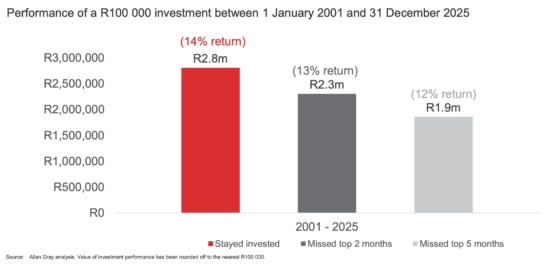
Source: Allan Gray
“It shows you how difficult it can be to time the market,” he says.
Naturally, the question that follows, Maboa notes, is the likelihood of an investor missing those best-performing months. He adds that it is more probable than one would think.
To illustrate this, he points to the 50 best days (in terms of return) of the Allan Gray Balanced Fund, as well as the 50 worst days.
ADVERTISEMENT:
CONTINUE READING BELOW
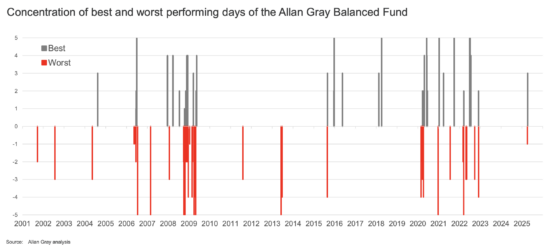
Source: Allan Gray
“What you see is that more often than not, the worst days are followed by the best days,” he explains.
“So when you try and exit the market when things feel uncertain, you’re probably going to do it at the wrong time and lock in losses and when you try and get back into the market, you’re going to do so when things feel a lot more comfortable and you are probably going to miss the recovery.”
“In being a diligent investor, this doesn’t lie in you being able to predict the future, but rather it lies in you being able to make sound investment decisions based on long term timelines when making these investment decisions”.
The manager is at pains to stress that time is the one variable that consistently improves the odds of success.
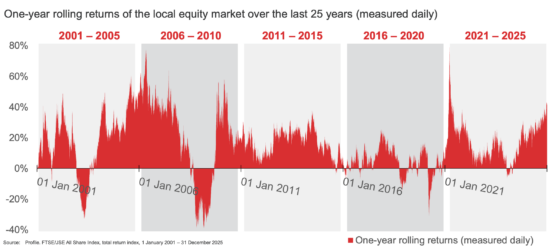
Source: Allan Gray
ADVERTISEMENT:
CONTINUE READING BELOW
The illustrate this, he shows that when looking at one-year returns on the JSE over the last 25 years (measured on a daily basis), it is “clear that over the short term, you’ll either see very sharp spikes or declines in the valuation.
“Now if you’re assessing whether you’re meeting your investment objectives over just two days, you could make really poor decisions,” says Maboa.
Read: Not just gold … why this major balanced fund has outperformed in 2025
He adds that if you then look at the percentage of time in which the JSE achieved real returns (in other words, after inflation) over the last 25-year period, this principle is reinforced.
If you assess it “over only a one-year period, the JSE would have outperformed inflation only 74% of the time, but if you assess that over five years, this increases to 96% and over 10 years, to 100% of the time”.
#time #market #couldve #cost #R1m #years