Top tickets to the 1994 World Cup finals in the US sold for $475. This year, finals tickets at MetLife Stadium in New Jersey are selling for more than $10 000.
It was far cheaper for a reason. Over 30 years ago, the prospects for the tournament were far from certain. The US, accustomed to superpower status in all things, was at best an also-ran in men’s national football.
It didn’t even have a proper domestic league. The old North American Soccer League had folded after the 1984 season, and Major League Soccer did not begin play until two years after the World Cup.
“We weren’t sure how successful it would be, but we knew Americans love a big event,” said Alan Rothenberg, chairman and chief executive of the 1994 tournament, who was also president of US Soccer at the time and oversaw the football matches for the 1984 LA Olympics.
Read: Fifa World Cup: How will that work in Trump’s America?
Rothenberg – an attorney who has also represented teams like the LA Lakers, LA Clippers and Portland Trailblazers, as well as athletes Bruce (now Caitlyn) Jenner and Greg Louganis – took advantage of his LA entertainment connections.
Whitney Houston, the Three Tenors, Robin Williams and other stars were drafted in to help draw crowds to stadiums. “We brought in every celebrity you could think of,” Rothenberg said.
But the suspicion the US wasn’t really a football nation was compounded at the opening ceremony, after Diana Ross danced the length of the pitch to take a penalty kick and yanked the ball far left of the goal, which was unfortunately rigged to split apart to simulate a wonder-strike.
This year, Fifa and the organisers have decided to copy the Super Bowl, America’s premier sporting occasion. For the first time, the final will feature a polished, halftime show featuring Madonna, Shakira and South Korean boy band BTS.
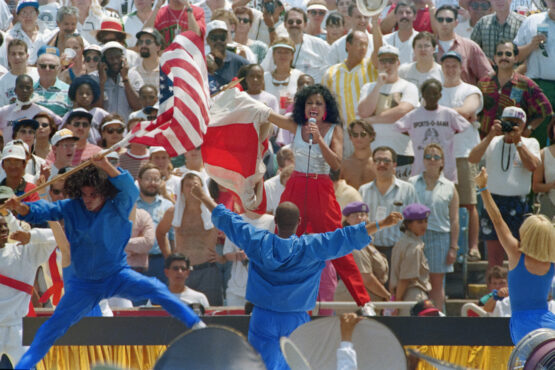
US singer Diana Ross sings to the crowd gathered inside Chicago’s Soldier Field stadium on 17 June 1994 during the opening ceremony for the 15th World Cup football. Image: Kazuhiro Nogi/AFP via Getty Images
Despite the early doubts, the ‘94 tournament began to pick up steam. Sponsors included a mix of enduring brands – Gillette, McDonald’s and Adidas – and some that have vanished, like Pontiac. Because play in football is rarely interrupted, unlike American football, US TV broadcasters had to figure out creative ways to slip ads into games.
ADVERTISEMENT
CONTINUE READING BELOW
ABC and ESPN turned the new on-screen score-and-clock box into advertising space, rotating brands including Snickers and Coca-Cola.
American fans, who’d been turned off by low scores, also learned to appreciate the game’s flow. “One great play, one awful play – it could be night or day,” Rothenberg said.
“The fans got their hearts in their mouth from the opening kick right to the end.”
Selling soccer to America
Football was so new to the US in 1994 that it was dubbed the sport’s “final frontier”. Magazine ads to promote the games showed a cowboy lassoing a football. Another, with the caption “In 1994, Football Season Starts On June 17th”, was illustrated with a photo of a man holding a football in the pose of American college football’s Heisman Trophy.
“I was handed a budget for an awareness campaign, like a new product launch,” said John Kristick, a sports consultant who oversaw promotion for the tournament. “It’s fundamentally different now. We are a soccer nation.”
The ‘94 US team’s strong showing was an unexpected bonus. They made it to the round of 16, beating powerhouse Colombia 2-1.
Colombia’s Andres Escobar, who scored an own goal, was assassinated days later upon returning home.
Then, the US faced Brazil on 4 July, Independence Day. The home crowd streaming into the stadium in Palo Alto, California, was as fired up as any in the world, Rothenberg recalled.
The US put up a fight in the first half but lost 1-0. Brazil went on to beat Italy 3-2 in a penalty shootout in the final at the Rose Bowl in Pasadena, California.
ADVERTISEMENT:
CONTINUE READING BELOW
The tournament turned a profit of $40 million – about $88 million today. Overall, attendance averaged 68 991 per match, and filled stadiums to about 96% capacity, making it one of the most successful World Cups
Today, much like in 1994, doubts are rampant about whether the World Cup will be a success. Many potential foreign visitors, wary of a hostile reception and high costs in the US, are staying away. And while organisers worried in 1994 about empty seats because of a lack of American fans, this year fans complain that high ticket costs are making the games affordable only for the ultra wealthy.
US World Cup – ‘games for the elite’
Los Angeles will host eight matches for the World Cup, including the US team opening match against Paraguay on Friday. “Unfortunately,” Los Angeles Mayor Karen Bass said, “this is the games for the elite of the world”.
Prices have been set high to prevent resellers from capitalising on the market, Fifa President Gianni Infantino said.
Distribution of this year’s 6.7 million tickets for 104 matches in 16 cities in the US, Canada and Mexico is electronic. In 1994, organisers printed more than 3.5 million pieces of paper for 52 games in nine US cities that were delivered by mail or other physical means from a centre in LA.
“We took over a bank vault,” Marla Messing, who managed ticket distribution then, said.
Read: 2026 Fifa World Cup: Economic boost will not be felt by all
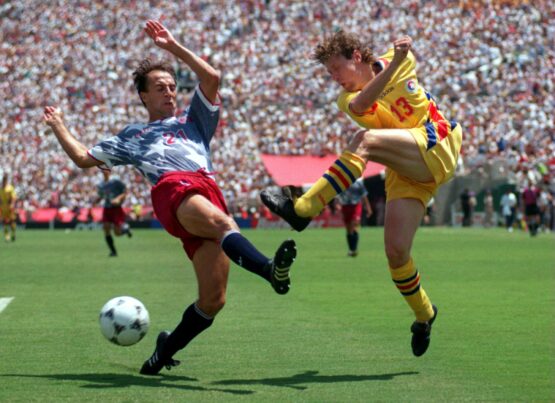
Tibor Selymes of Romania shoots past Fernando Clavijo of USA during their World Cup Group A match at the Rose Bowl Stadium in Pasadena, California, 26 June 1994. Image: Shaun Botterill/Getty Images
Messing later headed the 1999 US-hosted Fifa Women’s World Cup, which the US won on penalties at a Rose Bowl final, a victory immortalised in the photo of Brandi Chastain celebrating by ripping off her jersey.
“There’s always a lot of agita leading up to these big events, but once players take to the field, everything that went before it goes away and it’s just one of the greatest sporting events of all time,” Messing said.
ADVERTISEMENT:
CONTINUE READING BELOW
The ‘94 cup became a building block for the establishment of Major League Soccer, which now has 30 teams in the US and Canada with purpose-built stadiums and a $250-million-a-year broadcast deal with Apple TV. Still, the US hasn’t lived up to everyone’s expectations.
Read: Fifa optimistic amid chaos
“The United States of America is the number one country in the world,” Fifa’s Infantino said during a May visit to Beverly Hills.
“I do not understand how you can be satisfied to be number 20 in the number one sport in the world.”
The US lost in friendlies to Belgium and Portugal in March in Atlanta, but a victory over Senegal and a narrow loss to Germany has helped boost excitement. The odds of the US qualifying beyond the first round are currently about 83%, according to prediction market Kalshi.
Other professional sports leagues have grown faster. The value increases of franchises in the Women’s National Basketball Association and National Women’s Soccer League are outpacing MLS teams, according to Sportico.
And, in another worrisome sign, US youth participation in soccer fell in the last decade while individual sports like golf and tennis gained, according to Aspen Institute research. Veterans of 1994 expected a different trajectory after all this time.
“If you had asked me and with all that hair back in 1994 what it would look like going into the summer of 2026, 32 years later, I’ll be honest with you, I would have thought we would be much further along,” said Alexi Lalas, a defender on the ‘94 US team.
“I would have thought the conversation would be: Are we winning the World Cup? And that’s certainly not the conversation.”
© 2026 Bloomberg
#Remembering #World #Cup #tickets #cost