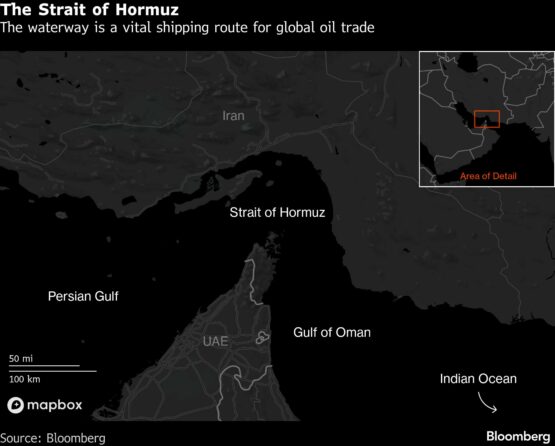
Oil flows through the Strait of Hormuz have surged by about 50% this month, according to Vortexa, underscoring what’s at stake as the US and Iran vie for control of the critical waterway.
Vortexa estimates that at least 1.8 million barrels a day of non-Iranian Persian Gulf oil left the waterway in the first 10 days of June, up from 1.2 million a day in May. Those figures tend to be revised upward as more tankers are observed, aided by satellite-image analysis. In contrast, no Iranian oil is flowing as a result of a blockade imposed by Washington, it said, underlining a growing level of US control in the region.
On Thursday, Tehran appeared to respond. Iran’s Persian Gulf Strait Authority, the body Tehran created to manage traffic through Hormuz, said the waterway would be closed until further notice.
The market reaction was muted, with Brent futures trading little changed. That’s a marked contrast to the 13% jump in prices that greeted Iran’s first shutdown of Hormuz at the outset of the war.
ADVERTISEMENT
CONTINUE READING BELOW
That may partly reflect the secret project President Trump unveiled on Thursday, in which the US military has helped about 100 million barrels of oil to clear Hormuz since last month. That would equate to at least 2.4 million barrels a day since the start of May, while traders and shipowners say volumes have increased in recent days, suggesting current figures could be even higher.
The large volume of escaping Gulf oil has combined with a collapse in Chinese crude imports and releases of emergency reserves to bring prices down by more than a quarter from their highs at the peak of the conflict.
So far, the renewed hostilities between the US and Iran haven’t ensnared regional energy assets, though traders will focus on whether ships can keep escaping in the face of Iran’s latest Hormuz closure.
“Transiting through the Strait without AIS signals has become the new norm,” said Xavier Tang, a senior market analyst at Vortexa, referring to the Automatic Identification System that vessels use to transmit locations and other identifying information during a voyage. He added that vessels shuttling cargoes for transfer onto other ships outside of the gulf makes it easier for buyers to purchase oil.
ADVERTISEMENT:
CONTINUE READING BELOW
The US has also ramped up its own attacks on ships it says are attempting to enter Iranian ports, hobbling Tehran’s flows. So far this week, Central Command has said that it disabled two vessels in the Gulf of Oman for attempting to breach a blockade that has been in place since mid-April, while a third ship suffered a fire in its engine room on Thursday.
In the early part of the war, transit for all ships through Hormuz was largely reliant on government-to-government deals, often requiring Iranian approval to transit. There were also a handful of swashbuckling shipowners who continued to cross the waterway despite an effective double blockade being in place.
On Thursday, Iran’s PGSA said that ships with permits to transit under its scheme should await further notification from the body after it announced the closure. Other states in the region have rejected the PGSA’s authority over Hormuz.
© 2026 Bloomberg
#Hormuz #oil #sneakouts #rise #Iran #vie #control