There is always one IPO that defines a generation of investors.
For people who started buying stocks in the 1990s, it was Microsoft (MSFT) and Amazon (AMZN). For millennials, it was Facebook and Tesla (TSLA). Each one arrived with the same problem, a valuation that looked impossible right up until it didn’t.
Elon Musk’s SpaceX, which has spent nearly a decade as the most-anticipated private company in the world, is about to test the next generation of buyers.
SpaceX filed its IPO prospectus on May 20 and is targeting a June 12 debut on the Nasdaq under the ticker SPCX, with a reported valuation range of $1.75 trillion to $2 trillion, according to Investing.com.
That would make it the largest initial public offering in history by a wide margin, eclipsing Saudi Aramco’s 2019 listing.
Even Jim Cramer is not sure the math gets there. The longtime CNBC host gave a blunt assessment of where the price sits right now, and three reasons it might not matter.
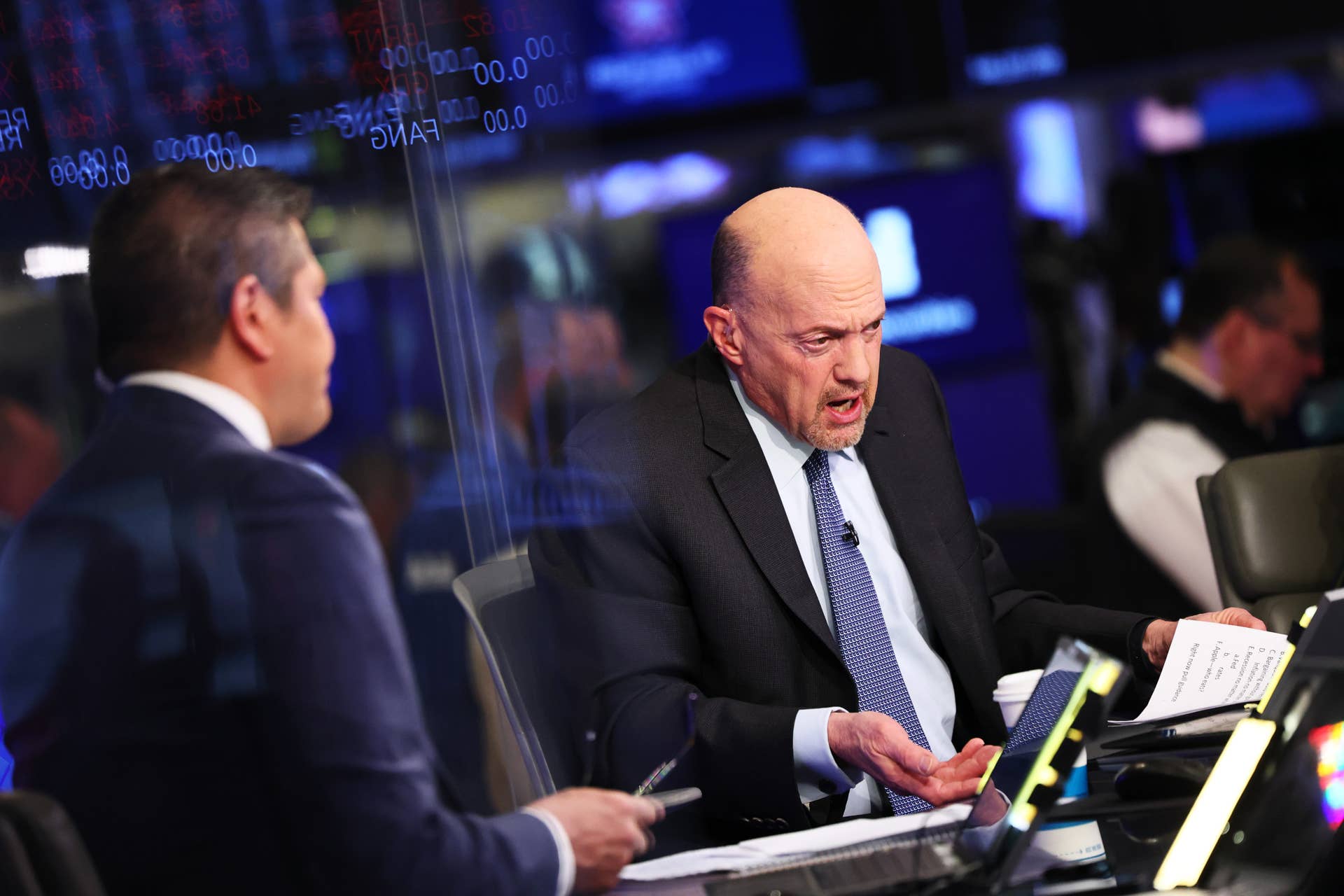
Photo by Michael M. Santiago on Getty Images
What Cramer told Mad Money viewers about SpaceX
Cramer addressed the SpaceX deal during the May 26 episode of CNBC’s “Mad Money,” and his opening line set the tone for the entire segment.
“Purely from the numbers, it’s very difficult to justify giving SpaceX a $2 trillion valuation,” Cramer said, according to CNBC.
More Wall Street:
- JPMorgan resets S&P 500 price target for the rest of 2026
- Vanguard challenges the S&P 500 as a one-stop strategy
- Goldman Sachs resets Broadcom stock forecast
He had reason to be cautious. The numbers themselves are extraordinary in both directions.
SpaceX generated $18.7 billion in revenue in 2025, up 33% year over year, but losses ballooned from a profit of $791 million in 2024 to a net loss of $4.94 billion last year, per the company’s IPO prospectus.
The bulk of that bleeding came from one place. Out of nearly $21 billion in capital spending last year, $12.7 billion went to building data centers for the xAI division Musk merged into SpaceX in February.
When I ran the implied valuation against trailing revenue, the math came out to roughly 110 times sales, higher than Tesla’s multiple at its 2010 IPO, per Investing.com.
That is the number Cramer kept circling back to. In my view, it is also the number that has every Wall Street strategist trying to figure out whether SPCX is the next Nvidia (NVDA) or the next WeWork.
Related: SpaceX’s long-anticipated IPO filing is out now — it’s full of red flags
Three catalysts that could rewrite the SpaceX bull case
The Mad Money host did not stop at the caution. He laid out three near-term events that, in his view, could make the price tag look reasonable in hindsight.
The first is Starship, the company’s next-generation reusable rocket. SpaceX completed its 12th Starship test on May 22, and the prospectus says the system is expected to begin payload delivery in the second half of 2026, according to CNBC.
“If SpaceX can really make that deadline, then it’ll be a major boon for their slowing space division,” Cramer said.
The second is a new compute partnership with AI startup Anthropic.
Per CNBC’s reporting, Anthropic will pay SpaceX roughly $1.25 billion per month through 2029 to lease computing capacity from the company’s Memphis data centers.
Last year, the SpaceX AI division generated just $3.2 billion in revenue, but the Anthropic agreement alone could add roughly $15 billion per year almost immediately, Cramer said on CNBC.
The third is the Cursor deal, which gives SpaceX the right to acquire the AI coding startup for $60 billion later this year or pay $10 billion for an ongoing partnership using its Colossus supercomputer, as reported by TechCrunch.
Here is how Cramer’s three catalysts stack up in dollar impact:
- Starship payload delivery: expected to begin in the second half of 2026, per the SpaceX prospectus.
- Anthropic compute deal: roughly $15 billion in incremental annual revenue, according to CNBC.
- Cursor partnership: $10 billion payment floor with a $60 billion acquisition option, per TechCrunch.
The reservation Cramer cannot get past
Three catalysts are not the same as three guarantees, and Cramer was careful to underline why he still cannot fully sign off on the deal.
The structural issue is the supply side of the market itself. The SpaceX IPO is not landing in isolation.
OpenAI and Anthropic are both expected to follow with their own listings carrying multi-hundred-billion-dollar price tags, per The Motley Fool, and that creates a math problem for everyone already long tech.
When several mega offerings hit the public market in the same window, eager investors have to sell existing holdings to participate. That selling pressure tends to weigh on the broader rally, not lift it.
The recent Cerebras Systems debut is the warning shot. The AI chip company surged nearly 70% on its first day of trading, pulling demand away from comparable growth names, according to The Motley Fool.
There is also the lock-up problem. Standard agreements prevent insiders from selling for 90 to 180 days after the IPO, which means a wave of insider supply hits the market right around Thanksgiving, exactly the moment retail enthusiasm tends to peak.
That is the gap between Cramer’s three catalysts and his one big reservation. The catalysts are about SpaceX’s business. The reservation is about what the IPO does to every other stock in the reader’s portfolio.
What the SpaceX IPO means for your portfolio
For most readers, the practical question is not whether to buy SpaceX at the open. It is what the deal does to the index funds and tech stocks they already own.
If SpaceX prices at the high end of its range, it joins Apple (AAPL), Microsoft, and Nvidia as the only U.S. companies trading above $2 trillion, per BitMEX.
Within weeks, Nasdaq fast-entry rules could push the stock into major benchmarks, which means every passive S&P 500 or Nasdaq 100 fund holder buys a piece of SpaceX whether they want one or not.
There is also the Musk concentration question. The prospectus confirmed the SpaceX CEO will control 85.1% of the voting power after the listing, with an incentive package tied to establishing a one-million-person Mars colony, according to TradingKey.
My analysis of the post-IPO ownership math says retail buyers are essentially renting a stake in Musk’s long-term ambitions, while institutional investors get the steadier cash flow from Starlink and government launch contracts. That is not a deal-breaker. It is a setup worth pricing into the position.
That is the trade Cramer is sizing up. Three catalysts that could make the price look cheap by Christmas, or one reservation that could make June 12 look like the top.
Either way, the answer arrives in less than three weeks. And every other megacap on the screen has to make room for it.
Related: BofA raises red flag on SpaceX, OpenAI IPOs
#Jim #Cramer #bold #Elon #Musk039s #SpaceX #IPO