Brent oil rose above $86 a barrel for the first time in a month, as US President Donald Trump reimposed a blockade on Iranian ships transiting the Strait of Hormuz and tensions rose after attacks on two tankers.
The global benchmark climbed as much as 3.6% after surging almost 10% on Monday. Risks in the Middle East surged after US forces carried out another round of strikes against Iran and Central Command said the military would resume blocking traffic to and from the Islamic Republic’s ports starting Tuesday. Two oil tankers sustained severe damage following strikes in the Strait of Hormuz, the United Arab Emirates said.
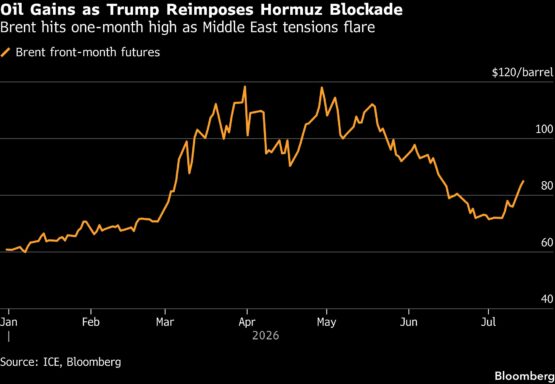
Oil has rebounded after earlier giving up all its wartime gains as the escalating conflict rekindles concerns over supplies from the Persian Gulf. Iran had managed to export at least 57 million barrels of crude during a brief gap between two the American naval blockades, with the reimposition of the blockade likely again choking off a key source of supply.
To add to the upheaval, Trump on Monday demanded a 20% reimbursement on cargoes passing through Hormuz. That would work out to roughly $30 million for every full supertankers at current oil prices.
ADVERTISEMENT
CONTINUE READING BELOW
Iran has been quietly moving oil tankers through the strait over the past few days as hostilities escalated. Six US-sanctioned supertankers transited the waterway into the Gulf of Oman over the past week with their transponders turned off, according to ship-tracking data compiled by Bloomberg.
“They were just shipping oil out at unbelievable rates,” said Jay Hatfield, chief executive officer at Infrastructure Capital Management. “We think we’ll hang around this $80 level, unless there’s some movement one way or another on the strait. But I don’t think we’ll go to, like, $90 or $100. And if the strait reopens, we’ll go to $60 in one hell of a hurry.”
European natural gas surged as much as 3.6% to the highest in more than three months. Before the conflict, about a fifth of the world’s crude and liquefied natural gas passed through the strait.
Iran’s army targeted US assets in Kuwait with drones and struck “a hostile vessel” with cruise missiles, the semi-official Fars news agency reported, citing an army statement. Meanwhile, the UAE said two of its tankers were attacked in Omani waters while transiting the southern route of the strait.
Over the past month, Persian Gulf producers had begun marketing additional crude after the interim agreement eased export concerns. The UAE in particular proved highly successful at moving barrels by utilizing shuttle tankers sailing dark, or with their transponders off.
ADVERTISEMENT:
CONTINUE READING BELOW
The UAE told OPEC that it increased crude production to 3.8 million barrels a day in June, up 1.71 million barrels from May, according to a monthly report seen by Bloomberg on Monday, after finding workarounds to the Iran conflict and ramping up output following its departure from the producer group.
The conflict also showed signs of widening beyond the Strait of Hormuz. Saudi Arabia’s air defenses engaged with ballistic missiles fired by Yemen’s Houthis on the country’s southern region, Alekhbariya reported, citing a Defense Ministry spokesman. Earlier, the Houthis said a Saudi airstrike hit Sanaa International Airport and vowed retaliation, opening another potential front in the area.
Elsewhere, Trump will support a Russian sanctions bill championed by the late Senator Lindsey Graham, according to a White House official who spoke on condition of anonymity. That would revive efforts to penalize buyers of Russian oil and natural gas and increase pressure on the Kremlin to end its war with Ukraine.
| Prices: |
|---|
|
© 2026 Bloomberg
#Oil #tops #barrel #Trump #reinstates #naval #blockade #Iran