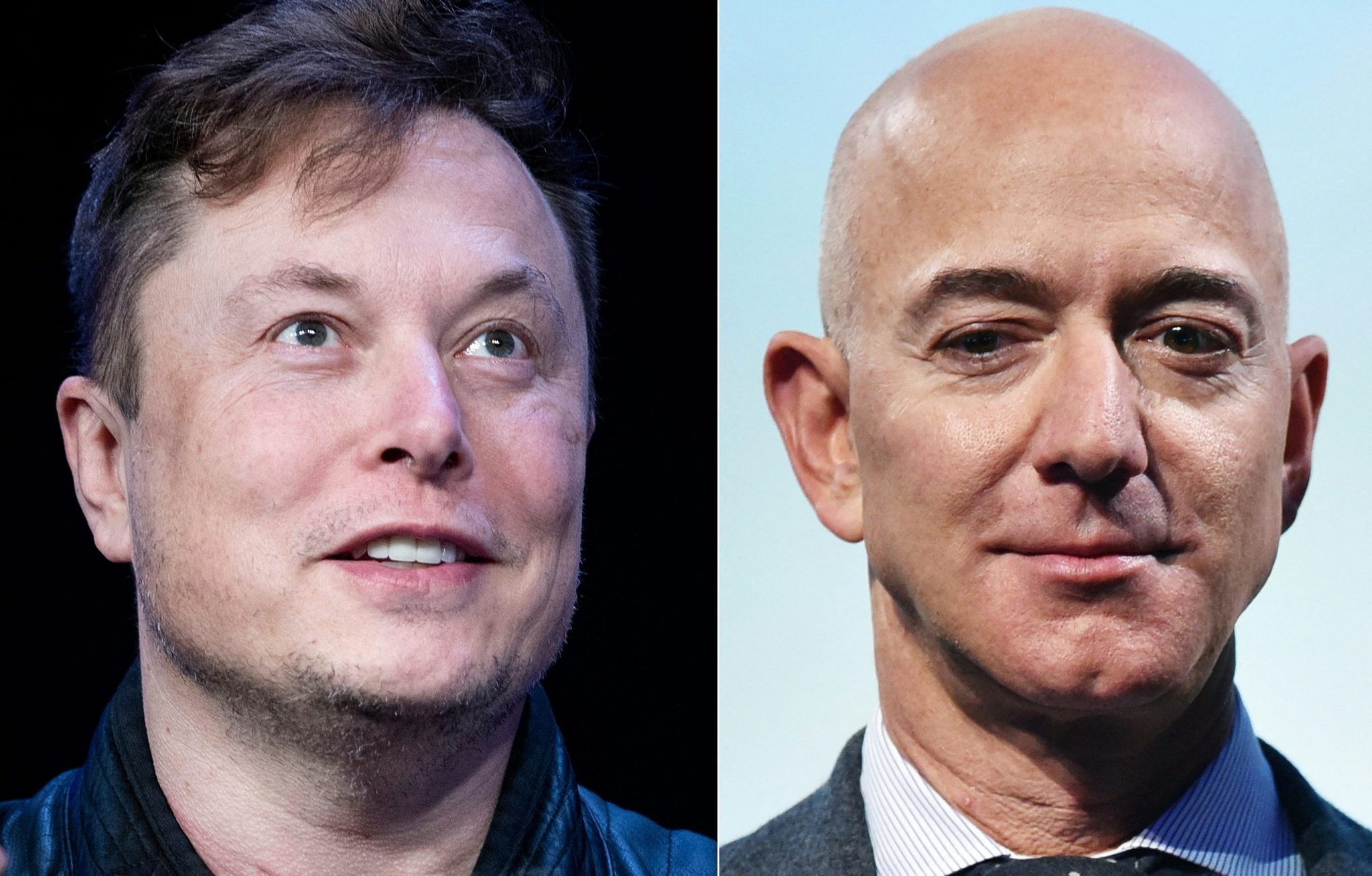
A charismatic founder with near-obsessive conviction, a business that bleeds money, and a stock price based on a wildly optimistic valuation.
In 1997, Jeff Bezos took Amazon public at a price of $18 per share at a $438 million valuation. The online bookseller’s stock would then crater 90% after the dot-com bubble burst, before flourishing into a $2.6 trillion conglomerate that raked in $77.7 billion last year.
Enter SpaceX in 2026.
Founded by Elon Musk, the company lost $4.9 billion last year, and went public at $135 a share in June, with a valuation that quickly rose to a sky-high $2 trillion.
The two mega-cap companies are primarily known for businesses that have little in common, with Amazon dominating the online retail business while SpaceX has become the world’s leading rocket maker. But look a little closer, and the two companies have strikingly similar silhouettes which seem likely to bump up against each other ever more frequently as they compete on the public market stage.
Perhaps more than any other tech companies out there today, Amazon and SpaceX are both conglomerates with broad collections of assets and businesses that each believe work together to create a more powerful whole. Both companies offer satellite-beamed high-speed internet access. They’re both in the cloud computing and AI infrastructure business with expensive data centers. Chips? Amazon’s Trainium and Graviton processors hit an annual revenue run rate above $20 billion in Q1, nearly doubling the $10 billion run rate from the previous quarter. SpaceX has a chip-manufacturing initiative called Terafab with a goal of producing one terawatt of compute hardware each year.
Amazon and SpaceX each also have advertising platforms, with Amazon ginning up $68.6 billion in ad revenue last year while SpaceX’s X platform—the social media service formerly known as Twitter—lived inside the AI segment that posted a $6.4 billion operating loss.
If you squint, you can see them as doppelgängers with one big difference—or to be more accurate, nearly 700 billion differences. Amazon hit $716.9 billion in revenue in 2025 and $80 billion in operating income compared to SpaceX’s $18.7 billion of revenue and a $2.6 billion operating loss.
Investors are focused on the opportunity ahead, of course. Amazon trades at roughly 3.6 times last year’s sales and about 28 times forward earnings. SpaceX trades at about 97 times sales, and had a $4.9 billion net loss.
“You’re basically buying [SpaceX] at an Amazon valuation when it has one-twentieth the revenue of Amazon,” said Jim Lebenthal, a veteran investor and chief markets strategist at Cerity Partners. “SpaceX is an incredibly cool company—it’s amazing, everything they’re doing. I also think it’s wildly overvalued right now.”
Looking at the rival companies piece by piece, you can see that in nearly every competitive line of business, Amazon is more profitable and growing. But it was also the company that took a nosedive that nobody wanted to own on the way down. Whether SpaceX can fill its shoes requires an extraordinary amount to go right, said Lebenthal.
Here’s a look at how the two multi-trillion tech conglomerates stack up.
Satellites
Starlink, SpaceX’s high-speed satellite-based internet service, is the company’s current golden child, with $11.4 billion in revenue last year. It counts United Airlines, Carnival, Maersk, and John Deere as customers, and grew 50% year over year, with $4.4 billion in operating income at a 39% margin. Starlink is SpaceX’s only profitable segment and a sum-of-the parts analysis from investment bank Stifel last week valued it at $1.25 trillion, just more than half of SpaceX’s $2.45 trillion enterprise value. But there’s a caveat. FactSet projects SpaceX will need to raise roughly $250 billion in debt over the next four years to fund its growth, according to Lebenthal, so a lot is riding on Starlink’s shoulders.
Amazon is the runt in this match-up. While Starlink has 9,600 satellites deployed and still in orbit, Amazon’s Leo has just started to really get into a groove with about 330 satellites, according to Stifel. But Amazon sees big potential in space. In April, Amazon agreed to acquire Globalstar for $11.6 billion with the goal of expanding Leo’s satellite network. And the company recently unveiled enterprise-grade Leo Ultra, which it says is the fastest satellite-internet antenna ever built. Amazon also inked deals with Delta Airlines and Jet Blue to expand wi-fi access on hundreds of aircraft in 2028.
Cloud and Compute
Amazon essentially invented the cloud business, and the company has the clear advantage right now. Amazon Web Services (AWS) posted $128.7 billion in revenue in 2025, with $45.6 billion in operating income at a 35% margin. AWS picked up the pace in the first quarter, growing 28% to $37.6 billion in revenue. Anthropic uses Amazon Trainium 2 chips to train Claude, and Amazon CEO Andy Jassy told investors that AWS’s AI revenue run rate topped $15 billion in Q1 2026 and is “ascending rapidly.”
SpaceX is moving fast though. The company already has Colossus I and II data centers, and has signed lease deals with Anthropic and Google. And the company says its ultimate goal is to send the AI buildout into orbit. In 2025, SpaceX’s AI segment generated $3.2 billion in total revenue against a $6.4 billion operating loss and in the first quarter of 2026 it lost $2.5 billion on $818 million in revenue.
Dan Niles, founder of Niles Investment Management said SpaceX’s compute operation today is more at a level with $5 billion CoreWeave or Amsterdam-based Nebius rather than at the level of AWS.
“I don’t view them as similar companies at all,” said Niles.
Justin Menne, a portfolio manager at Harbor Capital, sees it in terms of visibility. Amazon has a contracted backlog of $364 billion and competitive inference chips, he said, while SpaceX has plans to build.
“I think in order to believe that the total enterprise value makes sense here, you’re inherently giving a lot of credibility to the management team, the engineering team, in order to actually execute,” said Menne.
The Musk factor
Menne said he hadn’t done any modeling on how much the Musk premium adds to SpaceX’s valuation but the non-technical answer is, “a lot,” he said.
Lebenthal admires Musk’s accomplishments but called him “a source of discomfort” for some value investors.
“It’s because he says outlandishly optimistic things,” Lebenthal said,
Musk projected $1 trillion in revenue at SpaceX by 2030, while Lebenthal noted estimated revenues are about $40 billion for 2026.
“You can’t just say that and $960 billion of incremental revenue is going to come to the table,” he said. SpaceX is an innovation stock that really appeals to investors who are dreamers, he added, like Ark Invest’s Cathie Wood. On SpaceX’s first day of trading, Wood’s Ark invested about half a billion in SpaceX, and has purchased more as the price has ebbed since its opening day.
Amazon founder Jeff Bezos has a similar larger-than-life profile and reputation for entrepreneurial genius as Musk does. But Bezos transitioned from CEO to executive chairman in 2021 (he still reportedly has some involvement in important priorities like AI, but his day-to-day attention seems focused on Blue Origin, his space exploration company, and Prometheus, a new AI startup he cofounded).
Harbor Capital’s Menne said there is no equivalent key-man premium at Amazon because “the current value of the company is less reliant on the next five years of executing on something that doesn’t already exist.”
That said, Niles said there’s a clear alternative for investors drawn to Musk. The other public company where he serves as CEO, Tesla, has near-term initiatives that include robotics, autonomous fleets, and energy storage which “are likely to come to fruition before a colony on Mars,” said Niles.
Still, the Musk premium can’t be discounted.
“Elon has this talent for making money for investors, even if crazy projections don’t play out,” said Menne.
The $28.5 trillion TAM
SpaceX’s prospectus claims a total addressable market of $28.5 trillion—roughly the size of the U.S. GDP. Of that, $22.7 trillion is a third-party estimate of the entire global “digital economy.”
Value-minded Lebenthal noted that “it’s earnings you want, not TAM.”
Menne said the enterprise AI portion “is really hard to underwrite because companies have only just started actually charging for a lot of these services in a way that’s not gross-margin negative.”
Niles added that there’s inherent competition in that stratospheric figure.
“There are some really pretty good companies in that space,” he said. “Maybe you can take all that share from Microsoft and others, but I think Microsoft is a pretty good company.”
SpaceX is targeting a $1.6 trillion market for connectivity and $26.5 trillion for AI. But Amazon Leo is also gunning for the former. Amazon’s AWS generated $128.7 billion in cloud revenue last year, and hosts Anthropic and OpenAI while presiding over a $364 billion contracted backlog.
Both can throw down gauntlets over the TAM, but Amazon can point to revenue of $716 billion last year to SpaceX’s $18.7 billion.
#SpaceX #Amazon #tech #dopplegangers #worth #trillionand #theyre #headed #collision