A sudden burst of extreme price volatility in the coffee market has caught traders and analysts off-guard and left them bracing for more instability.
Prices for arabica coffee, the premium variety favored by Starbucks and other specialty roasters, had cooled this year on hopes of a record Brazilian coffee harvest, even though the beans have been slow to arrive in the US and Europe. Speculators and other technical drivers upended that in just hours.
Futures on Monday surged the most in 26 years, rocketing 19% and flipping the market from a steep loss for the year to a slight gain. Prices then sharply corrected on Tuesday.
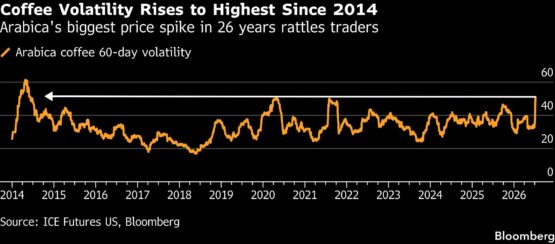
It’s the latest signal that massive fluctuations might be the new norm for the coffee industry, which has already been roiled in recent years by adverse weather and trade conflicts. A 60-day measure of volatility touched the highest level since 2014, surpassing even the volatility seen in the last two years, when arabica coffee futures set record highs.
“Coffee has officially entered meme-stock territory,” said Tomas Araujo, a senior trader at StoneX.
The coffee market has turned more bullish in recent weeks, as heavy rains delay the closely watched harvest in Brazil and the El Niño weather pattern takes effect. Stockpiles in exchange-monitored inventories are still at the lowest levels in over two years. But the magnitude of the price swing still caught players in the physical market off guard, who say they do see higher risks to the supply chain, though not a significant fundamental shift.
ADVERTISEMENT
CONTINUE READING BELOW
Enter the speculators, who likely accelerated the swing as they quickly covered short positions or fled the market with a more bullish narrative emerging. The market had been “trading on the idea of a surplus,” which is real but will take time to materialize in global stockpiles, said Rodrigo Costa, an experienced coffee trader and founder of commodities advisory firm Blue Route Partners.
A “huge allocation of assets away from energy markets” and into so-called soft commodities like coffee and cocoa was the initial driver of higher prices on Monday, said Sucafina quantitative trader Ilya Byzov, who added that the widely expected coffee surplus makes the session’s historic surge hard to justify.
Hedge funds in the week ending June 30 boosted bullish arabica coffee bets to the highest in seven weeks, and a rise in prices late last week was aided in part by the activity of speculative traders that use trend-following algorithms.
Meanwhile, the Intercontinental Exchange also raised the margin requirements for coffee futures, making it costlier for traders to stay in the market and potentially prompting more exits. Aggregate open interest — the number of outstanding futures and options contracts — has dropped to the lowest in about two months.
The flurry of activity likely drove prices above key thresholds, which then triggered even more activity.
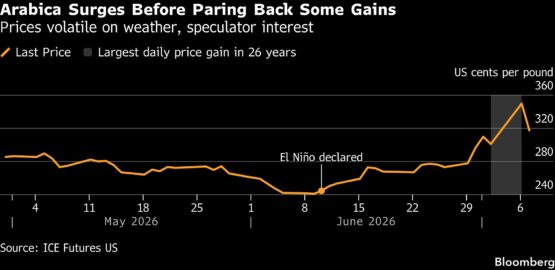
Arabica futures have surged about 27% since forecasters first declared an El Niño event this year, a weather phenomenon that forecasters say could be unusually strong this year. Hotter, drier weather during Brazil’s flowering season can reduce arabica yields.
ADVERTISEMENT:
CONTINUE READING BELOW
The price of cocoa, another tropical crop that is the focus of El Niño concerns, has likewise jumped more than 50% over that time frame as concerns grow about weather risks in West Africa, the top-growing region. New York cocoa futures surged as much as 14% on Monday.
“Cocoa and coffee are quite sensitive and have such wild swings because they’re produced in relatively concentrated areas,” said Dave Whitcomb, founder of Peak Trading Research. “Also these are relatively small markets. So when hedge funds sniff out a weather problem, they all hop on the same trade and rocket prices higher.”
Both coffee and cocoa markets have been volatile in recent years, due in part to adverse weather during the last El Niño weather pattern that was in effect in much of 2023 and 2024. Their movements are also somewhat connected as some trading houses participate in both markets.
That has market watchers, again, readying for more instability.
Yesterday “was the first shot across the bow,” said Les Finemore, chief investment officer at Moreton Capital Partners, which is starting a fund specifically trading El Niño crop risks.
Mike McDougall, an analyst at McDougall Global View, added that “the ongoing weather uncertainty is expected to keep coffee markets highly volatile in the weeks ahead,” even though Monday’s move was more speculative than fundamental.
© 2026 Bloomberg
#Wild #coffee #swings #usher #era #market #volatility