The International Monetary Fund (IMF) left its global growth forecast largely unchanged for this year, saying that the boom in artificial intelligence helped offset the fallout from the conflict in the Middle East.
“Global economic activity and the outlook are being shaped by two major forces, pushing in opposite directions with asymmetric effects across countries,” the Washington-based lender said in an update to its World Economic Outlook report published Wednesday.
“The global economy as a whole has, so far, weathered the shock from the war better than feared.”
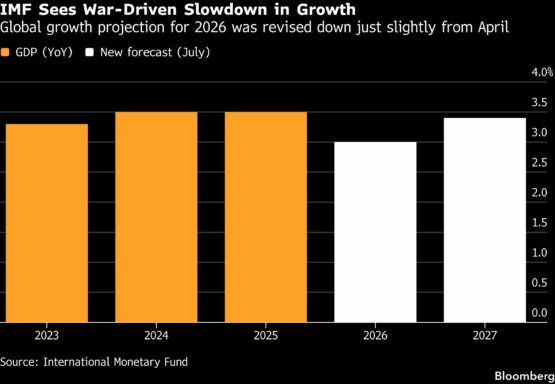
The fund expects growth of 3% in 2026, slightly down from the 3.1% predicted in April and a slowdown from the 3.5% average recorded over the previous two years. But the IMF cautioned that risks are “still tilted to the downside.”
Read:
Nvidia CEO says selloff in tech stocks is a buying opportunity
Nokia’s 140% rally turns AI comeback into valuation puzzle
The report, which was finalised before the latest flare-up between the US and Iran, cited the prospect of renewed tensions in the Middle East, further trade fragmentation and the possible unraveling of AI-driven expectations.
ADVERTISEMENT
CONTINUE READING BELOW
The US completed a fresh round of strikes following a series of attacks on merchant ships in the Strait of Hormuz, and US President Donald Trump said the tentative ceasefire with Iran had ended as far as he’s concerned.
He said Wednesday that the US would probably launch further strikes on Iran, ratcheting up pressure on Tehran and raising the prospect of a return to all-out war.
Read: Emerging stocks reclaim pre-war peak on Hormuz deal hopes, AI expectations
“What we’re seeing with the most recent developments overnight is that there is, of course, still a lot of uncertainty,” Petya Koeva Brooks, deputy director of the IMF’s research department, said in an interview on Bloomberg Television.
“Risks are very high,” she said, adding that an escalation in the conflict is a “primary driver” of those downside risks.
Higher inflation
Progress in bringing inflation down, meanwhile, has stalled. The IMF expects higher global consumer prices, raising its projections to a 4.7% gain this year from 4.4% previously, mainly due to energy and food costs.
The most significant downgrades in the growth outlook were in the Middle East region. Saudi Arabia saw its 2026 projection cut by 1.4 percentage points to 1.7% from 3.1% previously. Meanwhile, the IMF left its projection for the US unchanged at 2.3%.
ADVERTISEMENT:
CONTINUE READING BELOW
Much of what the lender called a “positive surprise” was concentrated in Asia among a few economies that are plugged into the AI supply chain, with exporters of related hardware outperforming in spite of their exposure to energy and trade disruptions linked to the war.
Read: World economy faces softer landing as IMF revises forecast
Among them is South Korea, whose economy rose an annualized 7.5% in the first quarter, more than four times the 1.8% projected in April, “despite its heavy reliance on imported energy from the Middle East”, the IMF said.
Thailand, Malaysia and Taiwan also outpaced expectations, benefiting from booming demand for AI-related equipment.
Growth for Thailand this year was revised up to 1.9% from 1.5%, reflecting emergency fiscal measures and robust technology-related exports and investment, the report said. Malaysia will benefit from a data center boost.
Meanwhile, the lender increased its global growth outlook for 2027 to 3.4% from 3.2% in April.
© 2026 Bloomberg
#IMF #helps #offset #wardriven #slowdown #sees #risks