Christopher Bejnar has spent the last couple of months combing through the fine print of exchange-traded funds, emailing financial advisers and moving money into European stocks – all to keep SpaceX out of his $1 million portfolio.
As Elon Musk’s newest public company heads into Nasdaq’s stock indexes this week, the 46-year-old software engineer in Philadelphia is making sure that none of his money is backing the Tesla and SpaceX founder who recently became the world’s first trillionaire. To stay away, Bejnar said he’s moved $50 000 into European index funds and bought shares of Rocket Lab Corp, a SpaceX rival.
“I’m on the anti-Elon side,” Bejnar said, pointing to Musk’s inflammatory political activism, and his extensive borrowing to support what Bejnar views as unproven technology at SpaceX. “Even if I’m only exposed by a tenth of a percent, I still wouldn’t want that going to him.”
Across Reddit, TikTok and online forums, investors like Bejnar have been swapping advice on how to avoid SpaceX as it enters flagship benchmarks like Russell 1000 Index and CRSP US Total Market Index, even if that means abandoning familiar ETFs or paying more for customized portfolios.
They are all part of the financial and personal maneuvering provoked by the rise of Musk, one of the most polarizing figures on Wall Street, if not the world. The shares of Musk’s first public company, Tesla, have been sent into the stratosphere by Musk’s loyal fan base of retail investors. That same crowd allowed SpaceX to make its spectacular debut on the stock market in June as the largest initial public offering in history.
Read:
Musk in the mirror
Musk’s SpaceX adds billions in debt while cutting interest costs
SpaceX rout set to push market value below $2trn
SpaceX is overvalued
Australia’s richest person Gina Rinehart described Musk as a “truly exceptional person,” and in June said she made a “significant investment” in SpaceX from her company Hancock Prospecting. Betting against the staying power of these believers has been a dangerous endeavor in the past, as many Tesla short sellers have learned. An investor who put $10,000 into Tesla would have roughly $3.5 million today, according to Bloomberg calculations.
That success, though, has led to some vehement critics. Musk’s role in President Donald Trump’s second administration and his strident participation in the culture wars have prompted protests, boycotts and a cottage industry of anti-Musk bumper stickers, turning opposition to the trillionaire into a movement that is spilling over into investor portfolios.
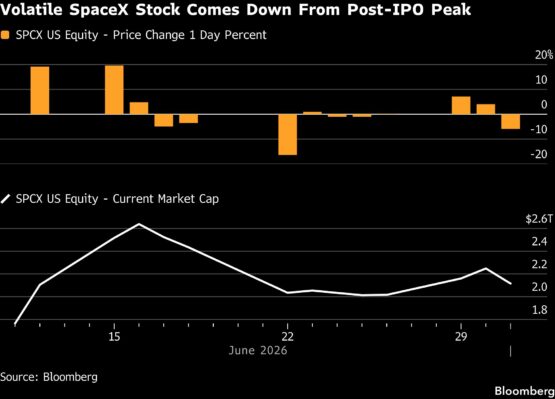
The strong personal feelings are compounded by the significant financial and occasional regulatory risks attached to Musk’s companies. SpaceX and Musk’s other public company, Tesla, both sit at valuations that dwarf peers and worry analysts. SpaceX surged right after it went public, but then fell as much as 24%, underscoring concerns that expectations had run ahead of fundamentals.
ADVERTISEMENT
CONTINUE READING BELOW
SpaceX and Musk didn’t respond to requests for comment.
The problem for Musk skeptics is that his stocks are so big they are becoming default holdings in most standard portfolios. Tesla already ranks among the largest companies in the S&P 500 and Nasdaq 100, which dictate the holdings of the broad-market ETFs that sit at the core of many retirement accounts. The electric carmaker accounts for 2% of the popular $980-billion Vanguard S&P 500 ETF (VOO) and more than 3% of the $490-billion Invesco QQQ Trust Series 1.
SpaceX’s entry into the public markets raises the stakes further. With a roughly $2.1 trillion market capitalization — 1.4 times that of Tesla — the company vaulted into the top tier of US stocks almost overnight.
After trading closes on Monday, SpaceX will be added to the Nasdaq 100 index following its previous entrance into the FTSE Russell and MSCI indexes. The moves are triggering billions of dollars of mechanical buying and put the stock into millions of passive investment portfolios. At a time when the shares are under pressure, they are likely to be buoyed by at least $5.4 billion of buying from index-tracking funds.
The unusually rapid addition of SpaceX to the indexes has sparked criticism because several providers made exceptions or revised their methodologies to accommodate the company despite its relatively small public float.
That float means that SpaceX’s weighting in major indexes will initially be relatively small, making up less than 1% in most indexes — well below Tesla. Still, financial advisers say they’ve fielded questions from a wide array of clients who want no part of a company controlled by Musk.
“I don’t think we’d be having this conversation if it wasn’t him,” said Emily Green, head of wealth management at Ellevest, who likened the current anti-Musk sentiment to the public fallout Meta Platforms faced after a series of scandals following the 2016 election. “There’s a number of people that didn’t want to own Tesla over the past couple of years” and they’re asking the same with SpaceX.
Direct indexing is the solution Ellevest offers clients – buying a basket of individual stocks that mirror an index, making it possible to exclude shares of companies an investor doesn’t want. Green said restricting just one or two stocks in a broad portfolio shouldn’t affect the overall performance due to returns from other holdings, and her clients who sought to avoid Tesla were at peace with the stock’s rise.
ADVERTISEMENT:
CONTINUE READING BELOW
“How we do it is we buy about 300 individual positions that span US large cap, mid cap, small cap and developed-market international stocks,” Green said. “People can customise it in a deep way and it can be a very personal thing.”
Read:
Elon Musk: World’s first trillionaire
Musk testifies he’s suing OpenAI to stop Altman’s ‘looting’
Bejnar said he wasn’t as concerned about having money in Tesla, but SpaceX changed the balance for him because of the way the company is borrowing and banking on Musk’s big but untested vision.
“It almost to me feels like he’s opening up credit cards to pay off other credit cards,” he said. “What I didn’t anticipate is that these index funds would change the rules to actually help him out.”
In recent weeks, Reddit posts about dodging SpaceX exposure have sprung up in subreddit groups like r/investing, r/ETFs and r/EnoughMuskSpam, generating reams of heated threads like one titled, “How to avoid investing in Elon Musk Companies.”
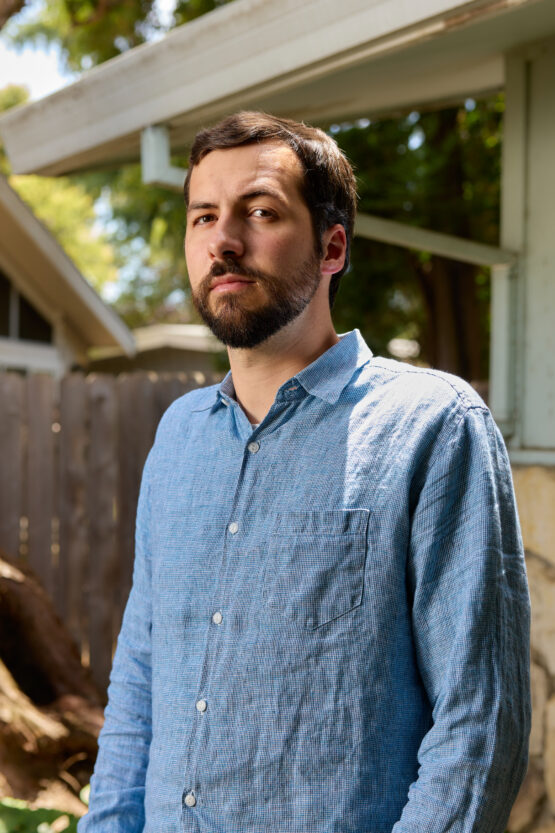
One of the posters was David Greer, a 30-year-old data analyst, who said he moved his $650,000 in retirement savings out of US index funds into international ones in April.
David Greer Photographer: Poppy Lynch/Bloomberg
Greer has been disillusioned with the second Trump administration and views Musk as “Trump of the tech world.” With Trump threatening to exit the North Atlantic Treaty Organization and exerting his “America First” foreign policy, Greer has lost confidence that the US will continue having the same strength, and stock returns, as before.
ADVERTISEMENT:
CONTINUE READING BELOW
“I don’t think it’s necessarily SpaceX exclusively that I’m trying to avoid,” said Greer, who lives in Davis, California. “But when it became clear that SpaceX was going to the market and that I would be invested, it felt like the straw that broke the camel’s back.”
Omar Qureshi, a financial adviser, has stayed away from buying SpaceX shares himself because he feels Musk is “an evil human being.” But as managing director at Hightower Signature Wealth, he’s helped clients participate in the IPO. To him, the debate goes beyond Musk and highlights the consequences of the passive investing boom that has transformed Wall Street over the past two decades.
As more retirement savings automatically flow into passively managed funds, index inclusion has become increasingly valuable, Qureshi said. The biggest companies receive a disproportionate share of new money, helping support their stock prices and making it harder for active managers to outperform.
“If you’re one of the big boys, you’re guaranteed to get flow,” said Qureshi. “It becomes a self-fulfilling prophecy. The inflows drive performance, which drives more money into the indexes.”
Still, neither Greer nor Bejnar wants to turn to actively managed funds. Greer prefers doing his own research and is still fond of the “set it and forget it” strategy with index funds. Bejnar, meantime, discussed options with his financial advisor before putting money from his managed brokerage account into a subset of ETFs that won’t contain SpaceX. His advisor cautioned that if the stock does well and gets added to every benchmark, it’ll become harder to avoid.
Bejnar believes it won’t be added to the S&P 500 any time soon given the index provider’s 12-month seasoning period and requirements for profitability and public float. SpaceX’s $25 billion debt sale in late June reinforced his conviction that it’s helping prop up debt associated with Musk’s broader business empire. He’s been encouraging friends and others on Reddit to join the anti-Musk exodus.
And what if SpaceX shares climb in the long run?
“I would not feel bad about never buying SpaceX, no matter how well it does,” he said.
© 2026 Bloomberg
#investors #scrambling #SpaceX #Elon #Musk #portfolios