Years of unreliable and costly electricity supply have transformed South Africa’s power landscape as companies take matters into their own hands.
Businesses have taken advantage of market reforms and invested billions of rand in renewable energy to protect against almost two decades of rolling blackouts and steep price increases that exposed the risks of relying solely on state-owned power utility Eskom and deteriorating municipal distribution networks.
Many of the major companies traded on the benchmark index in Johannesburg — spanning mining, real estate, retail and healthcare, among other sectors — say they’re working to boost renewables to lower dependency on Eskom and cut costs, with at least 40 firms in 2026 alone sharing such plans.
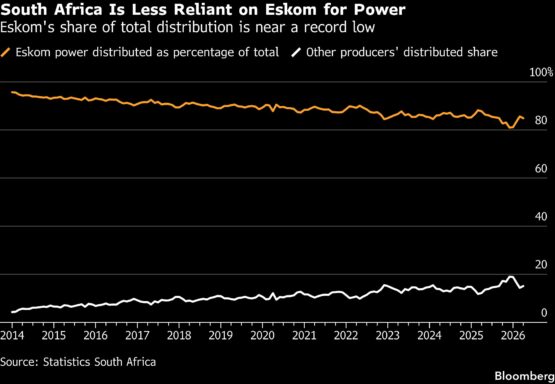
While Eskom has stabilised supply and managed more than a year without scheduled power cuts that throttle demand to prevent total grid collapse and are known as load shedding, homes and businesses are often exposed to prolonged local outages because towns and cities haven’t maintained or upgraded their cables and transformers.
The migration to private renewables supply is transforming Africa’s biggest electricity market from one dominated by a state monopoly into one where companies increasingly choose how and from whom they buy electricity.
Read:
New electricity price hikes push families deeper into the dark
Johannesburg faces R2.1bn funding gap as its bills mount
Vindication for Rural Maintenance in Mafube
“We had 102 years of a monopoly responsible for energy and now it’s a liberalised market where businesses can choose where they get their energy from,” said Andre Nepgen, the chief executive officer of Discovery Green, a renewable-energy trading platform set up by insurer Discovery in 2023.
Impala Platinum Holdings, the world’s No. 2 producer of the metal used in electronics and devices that cut vehicle emissions, is among the firms that have had to rethink how they power their operations in South Africa, home to most of the producer’s mines.
ADVERTISEMENT
CONTINUE READING BELOW
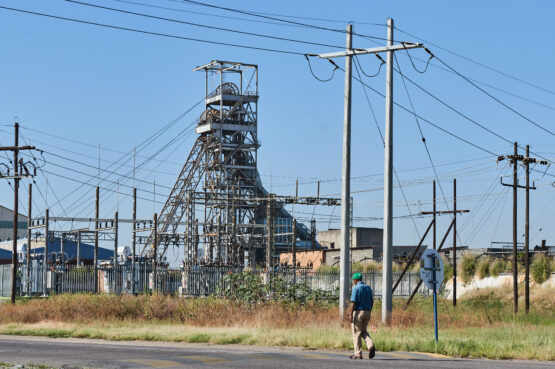
Power lines outside the Impala?s shaft 1 mine in Rustenburg, South Africa, on March 12, 2024. Photographer: Waldo Swiegers/Bloomberg
In 2024, it partnered with Discovery Green to obtain clean electricity for its refinery east of Johannesburg through wheeling, which involves buying power from off-site independent producers who then feed it into the national grid, allowing buyers to withdraw an equivalent amount at their location. It’s also exploring solar options for its biggest operation, Rustenburg, as well as the smaller Marula mine.
“Our decision was shaped by a convergence of factors rather than a single trigger” that include a climate imperative, operational realities and costs, Sustainable Development Executive Tsakani Mthombeni said by email. “South Africa’s electricity-supply constraints pose a direct risk to our operations’ safety and production,” with renewables bolstering security, he said, adding that reliability “is non-negotiable.”
The corporate renewable-energy market that Discovery Green is part of took off after 2021, when the state opened up private power generation and wheeling to tackle chronic shortages.
Government buying under its so-called Renewable Energy Independent Power Producer Procurement Programme initially drove growth in South Africa’s renewable industry. The latest expansion, however, has come from companies investing their own capital after the reforms opened the market to private generation and electricity trading.
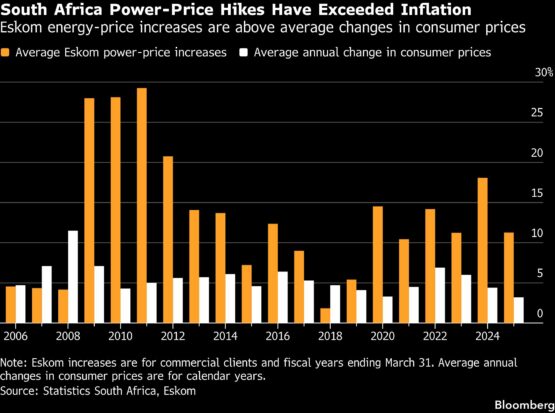
While supply constraints are among the chief drivers of the move to renewables, the cost of power is a big factor too. The regulator has allowed Eskom to raise tariffs by rates that have far exceeded inflation in recent years to help the company meet its obligations and as the government struggles to rein in non-paying municipalities. Prices have climbed almost 900% since 2008, equating to an average annual increase of about 15% since then. Eskom, meanwhile, still struggles with a long-term debt pile of R358 billion ($22 billion).
Read:
Here’s how to save thousands of rand as electricity tariffs soar
Johannesburg is not poor, it is badly managed
Johannesburg collapse risk spurs call for state to run city
These hikes have eaten into companies’ profit margins and they need to find cheaper alternatives, said Richard Doyle, managing director of JUWI South Africa, which builds and maintains solar and wind plants.
“The cost of buying energy from Eskom is over R2 ($0.12)” per kilowatt-hour, Doyle said. “The levelised cost of solar power now is maybe 50 to 60 cents. It is a complete commercial no-brainer for any and all industries now to move towards solar power.”
ADVERTISEMENT:
CONTINUE READING BELOW
Predictability is also a major motivating factor, said Nepgen.
“The certainty element of saying ‘this is my cost and it’s only going to increase by CPI’ is hugely valuable for businesses,” he said, referring to consumer price inflation. “When you’re deciding on whether or not to open a new facility, if you have uncertainty around your future electricity costs, that might discourage investment, so that CPI hedge really helps.”
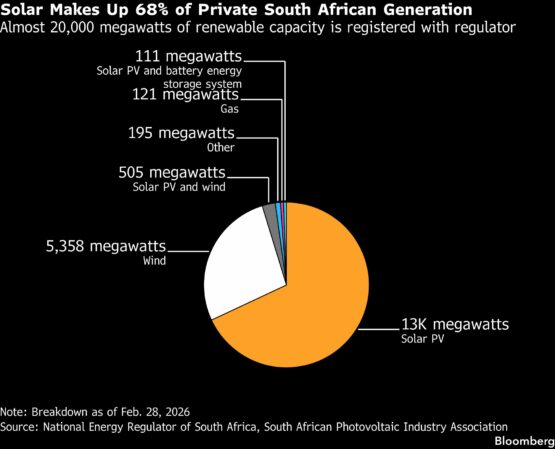
South Africa has more than 2 500 renewable-energy projects with 19 677 megawatts of generating capacity registered with the National Energy Regulator compared with under 20 megawatts in 2018, the South African Photovoltaic Industry Association said.
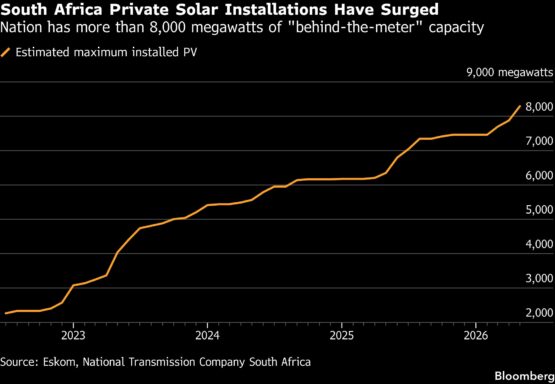
The National Transmission Company of South Africa separately estimates that the nation has about 8 400 megawatts of so-called behind-the-meter private-solar installations that generate power for on-site use and don’t supply the grid. The datasets aren’t comparable and likely overlap in part.
Eskom has total installed capacity of about 53 200 megawatts, 85% of which is coal.
The boom in private generation is redefining Eskom’s role in provision.
With consumers forced to find alternative sources of consistent supply, Eskom’s revenue has declined. And with their switch to lower-cost options eroding demand from the utility, it seeks bigger price increases that further cut clients’ reliance on it, deepening what the utility itself calls a “death spiral.” Eskom didn’t respond to a request for comment.
ADVERTISEMENT:
CONTINUE READING BELOW
The South African central bank has brought attention to the knock-on effects of inadequate public infrastructure on financial stability, noting in June that increased substitution with private generation also hurts the coffers of municipalities, many of which on-sell Eskom’s supply.
The company has responded by launching Eskom Green, a utility-scale renewable-energy developer that targets 6 000 megawatts of capacity by the end of the decade.
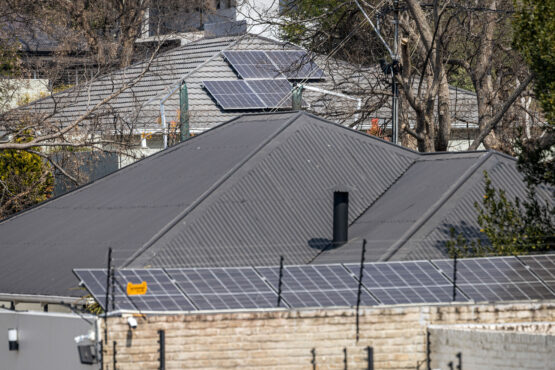
Solar panels on the roof of a house in Johannesburg, South Africa. Photographer: Michele Spatari/Bloomberg
The move “is a market signal that renewable energy is now considered essential and is no longer a luxury,” Impala’s Mthombeni said.
After more than a century of relying on a single dominant utility, businesses are gaining more choices about where their electricity comes from and how much they pay for it.
For Eskom, the challenge is no longer simply keeping the lights on. It’s adapting to a competitive electricity market where its biggest customers increasingly have alternatives.
“We expect renewable energy to play a central role in stabilising the country’s energy system,” Mthombeni said. “Renewable-energy technology will not replace the grid, but it will complement it — creating a more diversified, resilient and sustainable energy mix.”
© 2026 Bloomberg
#Corporate #South #Africa #accelerates #shift #Eskom #power