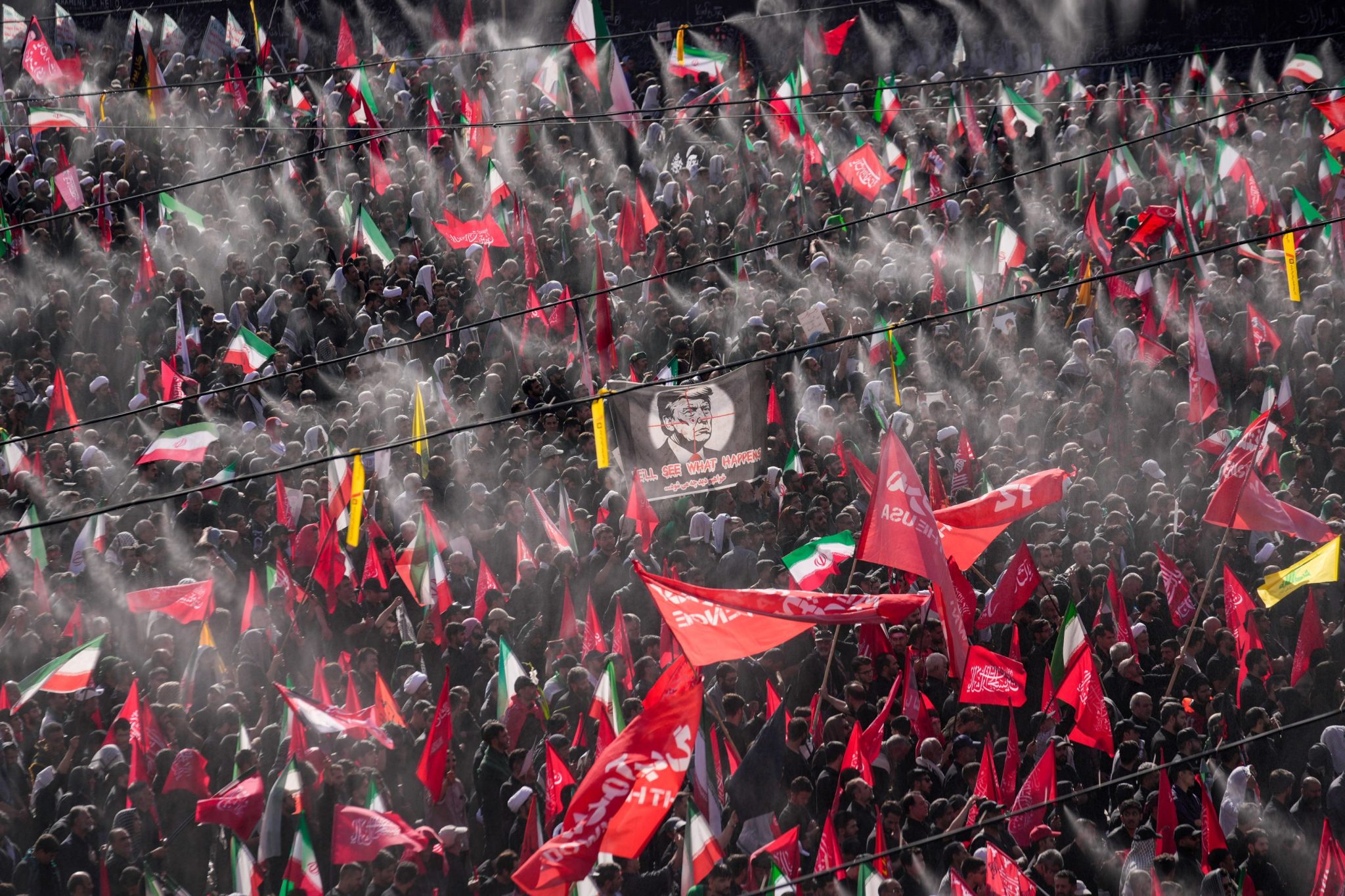
Iran’s top officials and brothers of the new supreme leader emerged into public view Sunday to attend funeral prayers for Ayatollah Ali Khamenei. Their appearance signaled confidence in their safety as Iran pushes back on U.S. demands in negotiations to permanently end the war.
Crowds of hundreds of thousands chanted “Death to America” and “Death to Israel,” as they called for revenge over the Feb. 28 attack that killed the 86-year-old supreme leader and other top officials, triggering the war. Some hard-liners called for the assassination of U.S. President Donald Trump.
Iran’s new supreme leader, Ayatollah Mojtaba Khamenei, has yet to make an appearance in the funeral ceremonies, which are unfolding over several days. He is believed to be in hiding after reportedly being wounded in the airstrike that killed his father.
At the height of the war, before an April ceasefire, Israel had targeted top leaders, in at least one case likely using their public appearance to fix their position. It has also threatened to kill the younger Khamenei.
The U.S. is meanwhile pressing ahead with negotiations with Iran aimed at fully reopening the Strait of Hormuz and rolling back its disputed nuclear program.
Ziba Naderi, a 42-year-old nurse attending the funeral Sunday, said Iran needed to heed Mojtaba Khamenei’s commands. “I heard the call for revenge, but our leader should say what we need to do,” she said. “And we must listen to him.”
Top officials appear as the crowd size swells
Ayatollah Jafar Sobhani, a 97-year-old Shiite cleric, led the prayers at Tehran’s Grand Mosalla for the late Khamenei his family members killed in the strike.
On hand were Khamenei’s other sons, Masoud, Meysam and Mostafa, who haven’t been seen since the war. Revolutionary Guard head Gen. Ahmad Vahidi, who was photographed for the first time since the war on Thursday, could be seen in the crowd by Associated Press journalists, flanked by plainclothes security forces and wearing a black baseball cap.
Iran’s President Masoud Pezeshkian, Parliament speaker Mohammad Bagher Qalibaf — who has led the negotiations with the U.S. — and Esmail Qaani, who leads the elite Quds Force of the paramilitary Revolutionary Guard, also attended.
The crowd had grown from the day before. Mourners dressed in black carried banners and flags honoring Khamenei.
Some mention Trump by name as mourners call for revenge
Posters and graffiti at the Grand Mosalla called for the killing of Trump and Israeli Prime Minister Benjamin Netanyahu.
“Why is the biggest bastard in the world still alive?” Mohammad Rasouli, a poet who emceed the event before the prayers, said to the crowd over loudspeakers, referring to Trump. “The world is no longer a good place” for Trump, he added as the crowd cheered.
“I came here to shout and seek revenge,” said Gholamreza Sabooni, a 29-year-old man who works in a grocery. “They killed our imam, we should kill their leader, Trump.”
The U.S. president was giving a speech at the same time across the world in Washington, D.C., for the 250th anniversary of America’s founding.
“We’ve had tremendous success,” Trump said about the U.S. military. “You look at Venezuela, you look at Iran. We wiped it out, wiped out their military.”
U.S. federal authorities have been tracking Iranian threats against Trump and other administration officials for years. That stems from Trump ordering the 2020 killing of Gen. Qassem Soleimani, who had led the Quds Force. Iran repeatedly has denied plotting to kill Trump, though hard-line propaganda footage long has suggested Trump was in Tehran’s crosshairs.
Trump meanwhile promised to destroy Iran’s very civilization during the war, among other threats.
Funeral postpones talks with US
Khamenei’s body will be transported to cities in Iran and neighboring Iraq, with authorities planning to drive his casket and others through the streets of Tehran on Monday. Authorities have shut down streets, airspace and daily life for the mourning, which will end Thursday as he is buried at the Imam Reza shrine in Mashhad, Khamenei’s place of birth.
Authorities offered no attendance count for the event Saturday and Sunday. Other cities across Iran also held mourning ceremonies.
Talks over reaching a permanent end to the war appear to be on hold until the end of the funeral.
The funeral was in part a show of unity and defiance as Iran demands a measure of control over the Strait of Hormuz, a vital waterway for global energy that it shut down during the war. The U.S. has rejected those demands, and the sides are divided on other key issues, including the conflict between Israel and the Iran-backed Hezbollah in Lebanon and Iran’s nuclear program.
The U.S. assisted 70 transits of the Strait of Hormuz over the past 72 hours, including 18 on Saturday, a multinational maritime body overseen by the U.S. Navy said Sunday. It called traffic steady along routes near Oman and Iran but still below prewar levels. The threat level remained “substantial” and mine clearance and surveying work continued.
“Our foreign policy should not be shaped in a way that allows our martyred leader’s blood to be dishonored and other countries can afford to do such things, without any serious response from our government and diplomatic system,” mourner Mohammad Reza Sharifi said.
#Iranians #demand #revenge #funeral #ceremonies #supreme #leader #killed #war