Southwest Airlines has spent the past year and a half rebuilding its business from the ground up.
Now that work is colliding with a once-in-a-generation opening: the collapse of Spirit Airlines.
And based on new research from Morgan Stanley, Southwest Airlines (LUV) planned for this moment long before its rivals even saw it coming.
Morgan Stanley analysts led by Ravi Shanker met with Southwest CFO Tom Doxey and Managing Director of Investor Relations Danielle Collins at the company’s Dallas headquarters.
Their takeaway was blunt. Management believes it has “their mojo back,” and Morgan Stanley now rates the stock “overweight” with a $60 price target, according to the firm’s June 30 note.
Spirit Airlines’ exit created rare opening
Spirit Airlines shut down for good on May 2, 2026, ending a 34-year run as the pioneer of the ultra-low-cost carrier model in the United States.
Spirit first filed for bankruptcy protection in November 2024, NPR noted, then filed again in August 2025 after its first restructuring failed to address deeper problems such as rising labor costs and a costly engine recall.
The final blow came from outside the industry entirely, CNBC indicated. A spike in jet fuel prices tied to the conflict in Iran shattered Spirit’s late-stage restructuring models.
More Airlines:
- Another low-cost airline leaves 6 cities, refunds available
- Delta Air Lines cuts two flights forever, refunds available
- Spirit Airlines won’t be coming back, and that costs flyers money
Emergency talks with the federal government over a loan or bailout fell apart, and Spirit entered liquidation.
That left a sudden gap in aircraft, gates, and landing slots across the country, and airlines are now racing to pick up the pieces.
Southwest Airlines saw it coming and planned for it
While most airlines were still sorting through what Spirit’s exit means for them, Southwest made its move.
Historically, the company shared about 30% of its routes with Spirit. By the time Spirit shut down, Southwest had trimmed that overlap down to 15%, according to Morgan Stanley’s note.
- The reduction shielded Southwest from the worst of the fare wars that typically follow a competitor’s collapse, while still positioning the airline to absorb the leisure demand Spirit leaves behind.
- Southwest has also pulled back at hubs like Chicago O’Hare and Washington Reagan National, where it already has a strong presence through secondary airports such as Chicago Midway.
- That freed up capacity to double down on high-growth leisure markets, including Orlando, Las Vegas, San Diego, and Austin.
CEO Bob Jordan described the network as something that has to keep moving.
Speaking at Bernstein’s Strategic Decisions Conference on May 28, Jordan said Southwest pulled capacity from Dulles and O’Hare simply because those routes weren’t generating the returns the company wanted, and that capacity is now going toward markets with stronger demand.
“Obviously, you hate to see somebody go out of business, but with Spirit out of business, I think that helps that environment,” Jordan explained. “So I do think the backdrop is constructive when fuel drops to retain the revenue and yield increases that we’ve seen. “
Southwest management is keeping overall capacity increases in the low single digits for now, even as fuel costs ease from their peak earlier this year.
Southwest’s new revenue playbook is paying off
Notably, Southwest moved to assigned seating and added extra legroom options in January, a major break from decades of open seating.
According to Morgan Stanley, the share of Southwest passengers paying extra for these add-ons has jumped from under 20% in the past to 60% today, with no sign of a ceiling.
Related: Southwest Airlines’ CEO makes startling admission
Jordan told the Bernstein audience that business travel revenue was up 25% year over year in March, and that momentum carried into April and May.
Rapid Rewards loyalty enrollments climbed 37% in the first quarter, and satisfaction scores among top-tier customers topped 90%.
Southwest is also weighing bigger bets, including airport lounges, a true first-class cabin, and eventually, long-haul international routes.
A high-speed WiFi rollout with Starlink is already underway, with roughly 300 aircraft expected to be converted by year’s end.
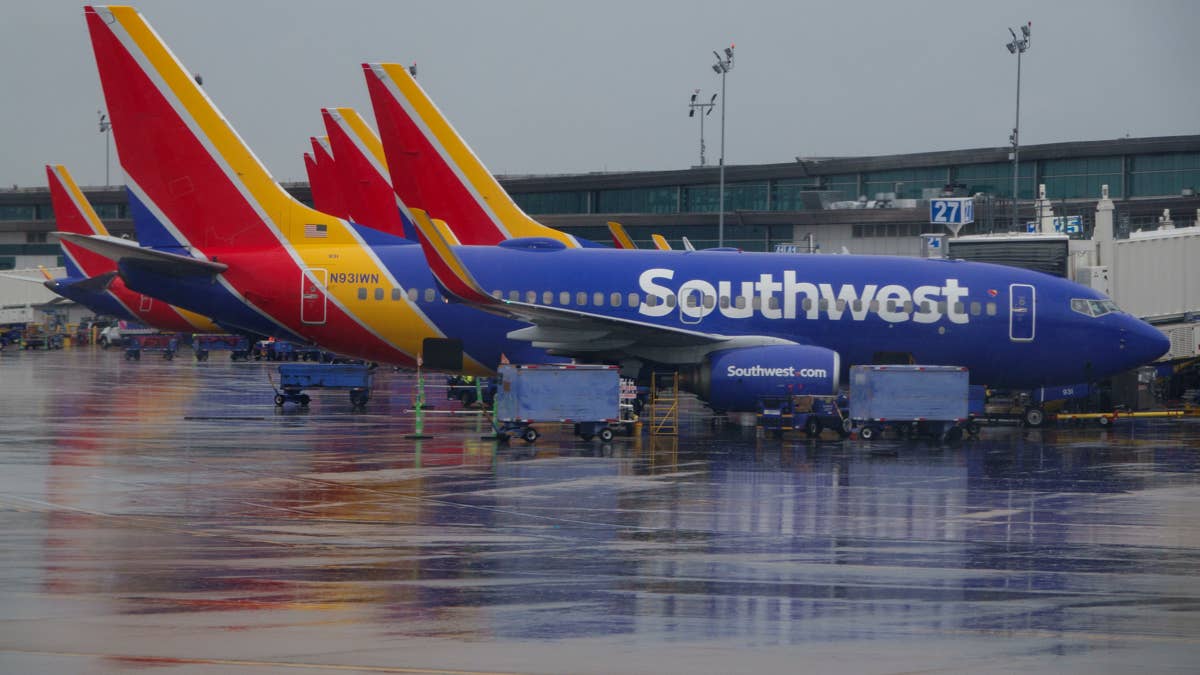
Kevin Carter/Getty Images
What it means for LUV stock investors
Morgan Stanley’s view is that the market has not fully priced in the durability of these changes.
The firm sees Southwest potentially joining Delta Air Lines and United Airlines as part of an elite “Quality 3” among U.S. airlines, a rerating case that could push shares above $75.
Morgan Stanley also flags a weaker macro backdrop, competitive fare pressure, and the chance of another operational disruption as the main threats to that outlook.
Fuel prices, still elevated after this year’s spike, remain the biggest wild card for how much of these gains Southwest can sustain.
For now, Southwest is the airline that planned ahead. Its rivals are still catching up.
Related: IATA issues stark message on fuel costs and airline profits
#Southwest #Airlines #leaves #rivals #flatfooted #bankrupt #carrier #folds