African economies from South Africa to Kenya bounced back in June and may get a further boost in coming months as the economic toll of the Iran conflict dissipates.
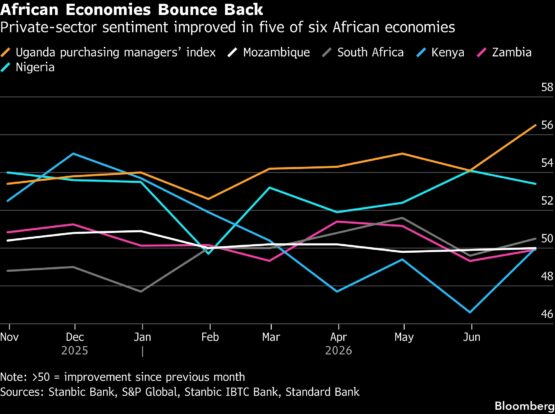
Gauges measuring private-sector sentiment rose in five of six African economies tracked by S&P Global, according to data released this week.
Oil prices have dropped about a fifth to below $72 per barrel since the US and Iran agreed an interim peace deal in mid-June to reopen the Strait of Hormuz, a key waterway for energy shipments.
Fuel importers Mozambique, Zambia, Uganda and South Africa’s purchasing managers’ indexes all increased, with the most pronounced rise occurring in Kenya. In Nigeria, Africa’s largest oil producer, the gauge fell slightly, though it remained above the 50 no-change mark.
ADVERTISEMENT
CONTINUE READING BELOW
While declining cost pressures were only really a factor for the index in South Africa — where it rose to 50.5 from 49.6 in May, indicating the third expansion in four months — the other fuel-importing nations are also likely to benefit from that impact in the coming months.
Read:
Oil wavers as Persian Gulf flows surge toward pre-war levels
Cautious optimism drives the markets
After South Africa’s inflationary pressures reached the highest levels for almost four years in May, rates of input price and output charge retreated, David Owen, principal economist at S&P Global Market Intelligence, said in a statement.
“With survey comments signaling that the recent cost spike has largely hinged on oil markets, a notable cooling of global oil prices over the course of June provides some confidence that inflation will moderate further,” he said.
The increase in Kenya’s index to the neutral mark of 50 in June from 46.6 a month earlier was a result of firms’ being the most confident about future activity in three-and-a-half years, as an increase in sales boosted sentiment and led to higher backlogs, fresh job creation and restocking efforts, S&P Global said.
ADVERTISEMENT:
CONTINUE READING BELOW
Even so, the survey signaled the quickest increase in private sector output charges in its history, reflecting higher fuel and raw-material costs and a stronger pass-through to consumers.
Read:
Oil extends drop as more barrels flow through Strait of Hormuz
Volatility, uncertainty hit JSE returns in first half of 2026
“Still, as international oil prices have been declining, there may be reprieve for firms in time,” said Christopher Legilisho, economist at Standard Bank Group.
Uganda’s and Mozambique’s improvements were underpinned by increases in output and new orders, and Zambia’s by positive sentiment in the year-ahead outlook. Nigeria’s drop to 53.4 in June from 54.1 was due to operating capacity, backlogs in work and supply-chain delays.
© 2026 Bloomberg
#African #economies #bounce #energy #prices #tumble #PMIs #show