Oil prices wavered in thin trading after their biggest quarterly slump since 2020, as flows from the Persian Gulf recovered toward pre-war levels and the US and Iran continued talks on a permanent peace deal.
The rebound in exports via the Strait of Hormuz at a time when fuel demand remains weak is fomenting a new surplus in key parts of the global market.
Crude exports from Saudi Arabia have surged to 90% of their pre-war level, mirroring a rebound in the United Arab Emirates. Iraq, among the hardest hit by the crisis, is finally showing signs of recovery, while a hoard of Iranian oil is also building up at sea.
Meanwhile, the US and Iran have held positive discussions in Qatar to convert their interim 60-day truce into a lasting settlement.
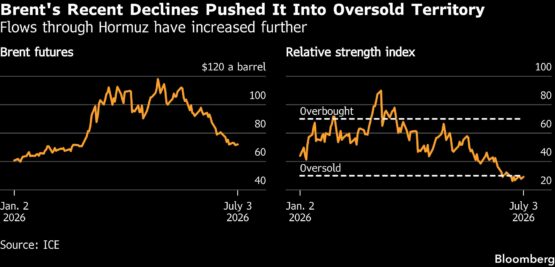
Brent futures traded below $72 a barrel in London, while West Texas Intermediate was below $69, with volumes depressed due to the US Independence Day holiday. Both benchmarks have erased their war-time rally, sliding around 30% in the second quarter.
ADVERTISEMENT
CONTINUE READING BELOW
Brent’s prompt spread has been in a bearish contango price structure for much of this week, with discounts on the nearest contracts signaling oversupply. Price differentials for cargoes in many regions are also languishing. Citigroup predicted the global benchmark could extend declines to $60 a barrel by year-end.
“Fundamentals are rapidly reasserting themselves as Hormuz disruptions fade” and “shipping flows are normalising,” Citigroup Inc. analysts including Francesco Martoccia and Eric Lee said in a note on July 2. “We continue to recommend selling any summer rallies and forecast Brent reaching $60 to $65 a barrel by the turn of the year.”
On the other hand, technical signals suggest the sell-off could have run its course. Brent’s 14-day relative strength index has fallen below 30, indicating futures may have been oversold.
“The US-Iran process remains fragile and disputes over Hormuz administration and transit fees persist,” the Citigroup analysts said.
ADVERTISEMENT:
CONTINUE READING BELOW
President Donald Trump said during an interview with CNBC that the US is still negotiating with Iran, and claimed the Islamic Republic “has agreed to just about everything we need.”
Diplomats offered to unfreeze billions of dollars of the nation’s funds held overseas in exchange for Tehran renouncing its claim over Hormuz and toll payments, but the Islamic Republic isn’t budging, the Wall Street Journal reported, citing people familiar with the discussions.
Sticking points including Tehran’s nuclear program and an end to fighting in Lebanon still stand to complicate discussions for a more permanent accord. Some European nations now believe that fees for transiting Hormuz are inevitable and ships making the crossing will have to pay Iran and Oman, according to people familiar.
| Prices: |
|---|
|
© 2026 Bloomberg
#Oil #wavers #Persian #Gulf #flows #surge #prewar #levels