Ebola could shave more than $1 billion from the Democratic Republic of Congo’s economy, push almost 1 million more people into poverty and ripple across neighboring states as authorities struggle to contain an outbreak spreading through one of Africa’s most fragile regions, a United Nations assessment found.
The outbreak, declared on May 15, “represents a complex development emergency” rather than a localised medical crisis, the United Nations Development Programme said in a report this week.
Even if transmission remains largely confined to Congo and Uganda, where at least 440 people have died, Africa could lose $2.37 billion in economic output because of trade disruptions, transport delays and tighter border controls, the agency estimated. In a scenario where the outbreak is compounded by wider geopolitical and supply-chain shocks, losses could reach $3.6 billion.
“Ebola does not stop at the hospital gate,” said Ahunna Eziakonwa, UN assistant secretary-general and UNDP’s regional director for Africa. “It affects livelihoods, education, food security, trade, public finances and trust.”
The epidemic is caused by the Bundibugyo strain of Ebola for which there is no approved vaccine or virus-specific treatment. Officials are relying on rapid diagnosis, contact tracing, supportive clinical care and community engagement to halt transmission.
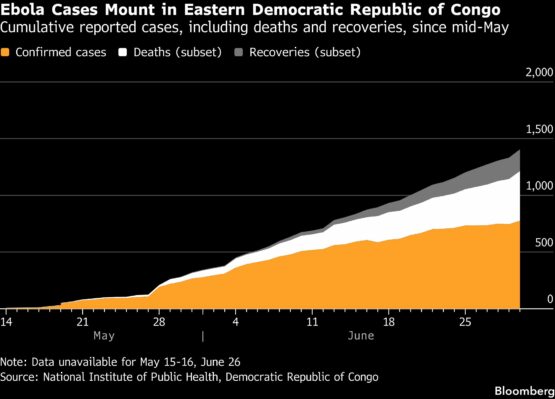
The response continues to face significant logistical and operational challenges.
ADVERTISEMENT
CONTINUE READING BELOW
Health authorities this week confirmed that infected contacts had traveled into Congo’s Haut-Uele province bordering South Sudan, raising concern the virus could spread beyond the three provinces officially affected by the outbreak.
Separately, the body of a pregnant woman who died from Ebola was carried more than 180 miles by motorcycle to neighboring Tshopo province before the infection was recognized, where testing at a morgue in Kisangani later confirmed the virus. The Haut-Uele and Tshopo cases had all been traced back to infections in Nia-Nia, in Ituri province, officials said in a report Wednesday.
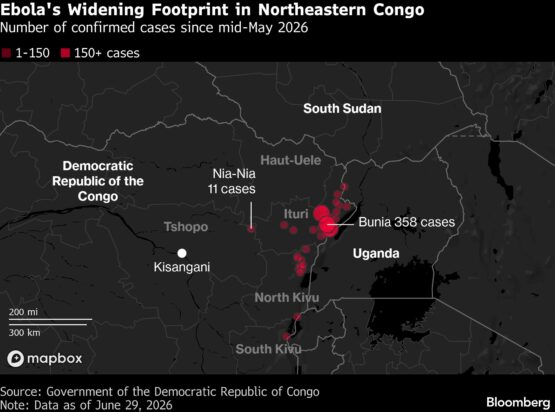
Ituri remains the epicenter of the outbreak, accounting for more than 90% of confirmed infections, and the growing caseload is straining the response. Officials also identified Lolwa as the 36th affected health zone nationally.
Treatment facilities in the province are operating above capacity. International Medical Corps said its 60-bed Ebola treatment center in Bunia is treating 75 confirmed and suspected patients and is expanding capacity to 80 beds.
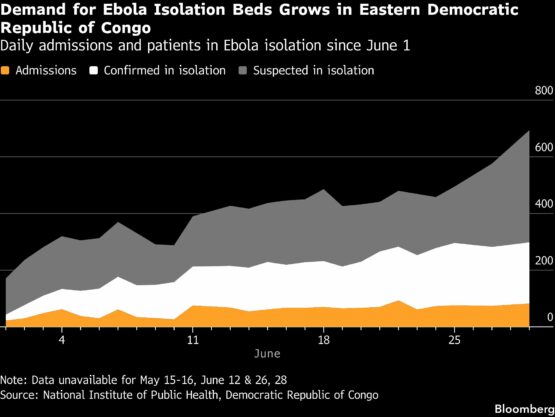
Laboratory testing in Ituri found 69 positive cases among 109 samples analyzed on June 30, a positivity rate of more than 63%, according to the situation report.
ADVERTISEMENT:
CONTINUE READING BELOW
A checkpoint under construction north of Bunia was set on fire by unidentified people Sunday night, while five patients fled isolation facilities before completing treatment or testing, the National Institute of Public Health said in a report Wednesday. Health workers are also attempting to monitor almost 12 000 contacts across the affected provinces.
Those setbacks are unfolding in a region where more than 260 armed groups operate and 5.8 million people have been displaced, complicating contact tracing, exposing health workers to violence and undermining trust in public-health efforts, according to the UNDP report.
The agency estimates the outbreak could reduce Congo’s economic output by about 1.6%, eliminate 55 000 jobs and push 985 000 more people into poverty. It could also divert health resources away from routine services, contributing to as many as 2 520 additional infant deaths from causes unrelated to Ebola.
Congo’s economy was worth about $91 billion in 2025, according to the World Bank.
Much of the economic damage is expected to come from disruptions to transport, informal trade, investment, and consumer confidence rather than the direct effects of the disease itself, the UNDP report said. Women will likely bear a disproportionate share of the burden because they dominate informal cross-border commerce while also serving as front-line health workers and family caregivers.
The regional burden on health authorities increased further this week after a fatal case of Marburg, a related viral disease, was detected in Uganda in a young child while authorities were conducting Ebola surveillance. No contacts reportedly developed symptoms and there was no evidence of an active Marburg outbreak.
© 2026 Bloomberg
#Ebola #cost #Congo #1bn #agency