More than 900 people were arrested across the country during the 30 June anti-immigrant demonstrations on Tuesday. This was confirmed by South Africa’s National Joint Operational and Intelligence Structure (NatJoints) in a media briefing on Wednesday.
The update comes a day after anti-illegal immigration lobbyists, including the prominent March and March movement, placed an arbitrary deadline for undocumented migrants to leave the country.
Read: Heavy police presence keeps a lid on anti-immigrant violence
The protests stem from repeated calls for the South African government to address the crisis of undocumented immigration, with some lobby groups arguing it is putting undue pressure on the country’s already stretched resources, including jobs, healthcare, education and other public services.
While demonstrations across all nine provinces were largely peaceful, police confirmed a number of isolated incidents of unrest.
Of the 120 marches tallied nationwide, 108 were described by police as peaceful, while 12 required law enforcement intervention due to outbreaks of unrest.
The incidents was reported in the Eastern cape, Gauteng, KwaZulu-Natal (KZN), Mpumalanga, the Northern Cape and the Western Cape.
“While the vast majority of demonstrations remained peaceful, there were individuals who sought to exploit yesterday’s events to commit criminal acts,” said NatJoints chair Tebello Mosikili.
ADVERTISEMENT
CONTINUE READING BELOW
“The majority of those arrested were illegal foreigners and [people engaged in] looting as a result of law enforcement operations conducted alongside the protests. Some were arrested for public violence, some for harbouring illegal immigrants, and business robbery at spaza shops,” she said.
Breakdown of arrests
- Western Cape: 215 arrests for offences including public violence and contravention of the Immigration Act.
- Eastern Cape: 208 arrests for offences including public violence, contravention of the Immigration Act, incitement to commit violence, and looting.
- KZN: 153 arrests for offences including looting, public violence and contravention of the Immigration Act.
- Free State: 132 arrests for offences including public violence, contravention of the Immigration Act, looting and business robberies.
- North West: 83 arrests for offences including looting, public violence and contravention of the Immigration Act.
- Gauteng: More than 82 arrests for offences including looting, public violence and contravention of the Immigration Act.
- Northern Cape: 51 arrests for offences including looting, public violence and contravention of the Immigration Act.
- Limpopo: 26 suspects arrested for offences including looting, public violence and contravention of the Immigration Act.
- Mpumalanga: Seven arrests on charges related to public violence.
Guesthouses, business owners and households are among those expected to appear in court soon, for allegedly harbouring undocumented immigrants.
Read/ listen: Business braces for fallout from anti-immigration protests
“We do have those that have people that are working for them as gardeners, as domestic workers that aren’t having proper documentation. So, we cannot allow a one-sided or picky side of the law,” Mosikili said, warning of punishment of those still breaking the law.
As a precaution, retailers and other business at the epicentre of the marches in Gauteng and KZN closed shop, including in the Johannesburg and Durban CBDs.
The economic cost of the closures is yet to be quantified.
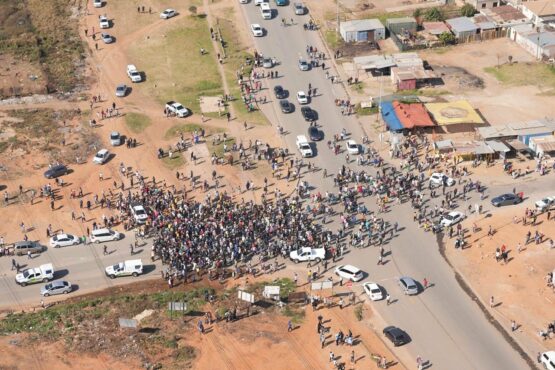
Image: SAPS
ADVERTISEMENT:
CONTINUE READING BELOW
One fatality was confirmed, but not as a direct consequence of violence or unrest.
A bus driver lost his life in a road accident in Limpopo while transporting 65 Malawian nationals who were being repatriated from Durban.
The bus was en route to Musina, where the passengers were due to be processed by the authorities before being facilitated through the Beitbridge Port of Entry as part of the repatriation process.
Ten other people were injured in the accident.
According to official figures, more than 4 200 foreign nationals have been repatriated and a further 400-odd deported in the past few days.
More than 40 000 illegal foreign nationals have been arrested since the beginning of 2026.
The exact number of undocumented migrants in the country remains contested, with no exact measure to account for those who come into the country illegally.
ADVERTISEMENT:
CONTINUE READING BELOW
What now? Beyond 30 June
Leaders and associates of March and March have indicated plans to continue staging protests every Thursday for at least six months, or until their demands are met.
These include:
- Stricter enforcement of immigration laws;
- Stronger border controls;
- Prioritising South African citizens’ access to jobs and public services; and
- Greater accountability in the implementation of immigration policy.
Law enforcement is expected to remain on high alert to monitor any resurgence of violence or disruptions, although the R600 million deployment of police and the army is likely to be scaled down soon.
In an earlier statement, the South African government said it will continue to intensify efforts against criminality, corruption, human trafficking, labour exploitation and all forms of illegality linked to irregular migration, while ensuring that enforcement actions are carried out within the framework of the Constitution and the law.
“Our objective remains clear: a South Africa where immigration laws are respected and enforced, where borders are secure, where communities are safe, where businesses compete fairly, and where human dignity and constitutional values are upheld,” the statement reads.
Read:
SA business warn government over xenophobia backlash
SA companies face backlash over anti-immigrant protests
South African minister urges police to find xenophobic agitators
#arrested #June #antiimmigration #protests