Alice Guéhennec’s technology career got off to an early start. As a child raised in France, she was just six when she received her first Commodore desktop computer.
But it wasn’t until Guéhennec studied IT and computer science at a research university in northern France that her interest in technology kicked into high gear.
After more than a decade in consulting, Guéhennec’s career quickly accelerated and she has held C-suite technology titles four times during her career, including as deputy chief information officer at the government agency Préfecture de Police in Paris, CIO in France at foodservice giant Sodexo, and then group chief digital and information officer at water management services company Saur, before returning to Sodexo in September 2023 to serve as chief tech, data, and digital officer.
It is in this role that Guéhennec oversees an annual tech budget of around 500 million euros ($571 million USD) for the Fortune 500 Europe company, which ranked No. 156 on the latest list. Those technology investments include an artificial intelligence tool that’s intended to get chefs away from their laptops and allow them to spend more time in the kitchen conceptualizing new dishes. AI is also being used to manage staffing levels and automate purchasing and pricing decisions.
“It’s about increasing adoption and putting AI everywhere at scale,” says Guéhennec, of her focus since returning to Sodexo.
Sodexo, which generates around $28 billion in annual revenue, operates a vast business tht generates 60% of sales from food services provided to schools, corporate offices, stadiums, hospitals, and airport lounges. This part of the business is subject to choppy swings in demand, from when schools are in or out of session to when stadiums host a game, and even the uneven return-to-office policies that can make it difficult for Sodexo and the companies and government agencies it serves to plan for demand.
On top of that, Sodexo has to confront ingredient variabilities due to the seasonality of fresh produce and volatile food prices; the latter linked to external stressors such as the war in Iran and global tariffs.
Guéhennec developed an internal AI tool called “Menu AI,” which she says helps automate all the decisions chefs need to make to conceptualize a new menu item, while also taking into account raw material price fluctuations, seasonality, and on-site demand. Sodexo says this AI tool has been able to generate and manage menus from a pool of 400 seasonal recipes in a single day, rather than the two to four weeks of manual work that would have been necessary before AI.
“It’s deployed to thousands of sites,” says Guéhennec. “All these teams were losing time behind laptops, when their core business is to cook.”
Sodexo is also exploring the application of AI to help incorporate food trends that emerge on social media and other external channels, which could help speed up the creation of trendier menu creations. “We are working to have AI that builds new recipes based on the trends on the market,” adds Guéhennec. “But it’s still under construction.”
The other 40% of Sodexo’s revenue comes from facilities management. It is there that Guéhennec has invested in AI tools that help on-site managers plan their staffing levels and track when a room has been used enough to require a cleaning, rather than just sprucing up every room on a regular basis even if it isn’t needed. AI is also being used to make data-driven recommendations, such as telling to tell one site it should restock coffee at 4 PM to meet demand, but that another location can skip afternoon refills.
Guéhennec says that every major AI use case is initially piloted at around five to ten sites in a couple of the 43 countries that Sodexo serves. She believes that on-the-ground, localized feedback at this stage “helps us to encourage and facilitate adoption.” Every employee is encouraged to request licenses for AI services like Microsoft Copilot or Google Gemini Enterprise if they think it can help make them more productive at work.
“You have to give people freedom with AI if you want them to adopt it,” says Guéhennec. “If it’s just a top-down approach, I think it doesn’t work.”
Sodexo is in the very early stages of experimenting with frictionless stores, which use AI and computer vision to eliminate a dedicated cashier station. The technology, which hasn’t had the smoothest rollout when big retailers like Amazon tried to create their own version of it, has been deployed at two different universities in St. Louis. At one school, Sodexo says the checkout-free retail experience has increased revenue by 56%. The other, unnamed university is seeing a 28% lift in sales and an 11% boost to the average check size.
The company has also deployed about 200 robots globally, including 100 floor-cleaning robots across all regions and 85 delivery robots, most of them in the U.S. What could be next: robots in the kitchen that can take on highly repetitive and, at times, potentially risky tasks.
“We are looking for some robots like this,” says Guéhennec. “To reduce the danger and level of accidents in our kitchens and to replace the less safe tasks with robots.”
John Kell
Send thoughts or suggestions to CIO Intelligence here.
NEWS PACKETS
Wall Street takes a more bearish view on AI’s hype cycle. The so-called Magnificent 7—Microsoft, Nvidia, Alphabet, Apple, Meta, Tesla, and Amazon—lost $2.3 trillion in market value in June as investors questioned the massive spending many of those companies have committed to AI infrastructure, partly fueled by debt and without a clear payoff in demand. Wall Street analysts told CNBC that those market fears may continue to linger until after second-quarter earnings reports are released this summer and offer more clarity on the AI strategies of these tech giants. On the other side of the coin, questions are being raised about how much revenue AI giants OpenAI and Anthropic can generate from enterprise clients for their AI tools, as costs have ballooned and some businesses are beginning to impose constraints on token spending.
OpenAI limits rollout of its latest AI model. On Friday, OpenAI announced that it agreed to make its newest AI model, GPT-5.6 Sol, available only to customers that were approved by the U.S. government, after a request from the Trump administration to restrict access. The ChatGPT maker said it believed broader access would be available in the coming weeks, while also taking mild issue with the government’s greater involvement in AI model rollouts. “We don’t believe this kind of government access process should become the long-term default,” said OpenAI. Meanwhile, Anthropic—which has had a far more turbulent relationship with the federal government than OpenAI—on Monday struck a state-level deal with California that will expand the use of the company’s Claude products to state and local agencies at a discounted cost.
Google reportedly limits Meta’s Gemini usage. The Financial Times reported that Google has curbed Meta’s use of its AI models after the Facebook and Instagram parent company wanted to use more computing capacity than Google could provide. Three people familiar with the matter told the news outlet that “several other Google clients” were impacted by the restrictions, though to a lesser extent than Meta. And so, while investors are fretting about the billions that tech giants have committed to invest in AI chips and data centers, and some companies are restricting usage as their AI bills have become too bloated, the underlying infrastructure is still not sufficiently able to handle soaring demand for AI services.
OpenAI may delay its IPO to 2027. For months, the media hype around OpenAI and Anthropic has centered on which AI hyperscaler would debut on the public markets first. Both were anticipated to debut in 2026, with Anthropic poised to launch an initial public offering by the fall after confidentially filing draft paperwork, but the New York Times reports that OpenAI may be willing to sit on the sidelines a bit longer. Weaker global markets, which have impacted tech stock valuations, and the turbulent performance of SpaceX’s recent massive IPO were among the top concerns cited by insiders who have made the case that patience is a virtue. Another sticking point: OpenAI CEO Sam Altman is reportedly insisting on a valuation of $1 trillion, but advisers say OpenAI must either wait until 2027 to achieve that figure, or the company can go public earlier, but at a lower valuation.
ADOPTION CURVE
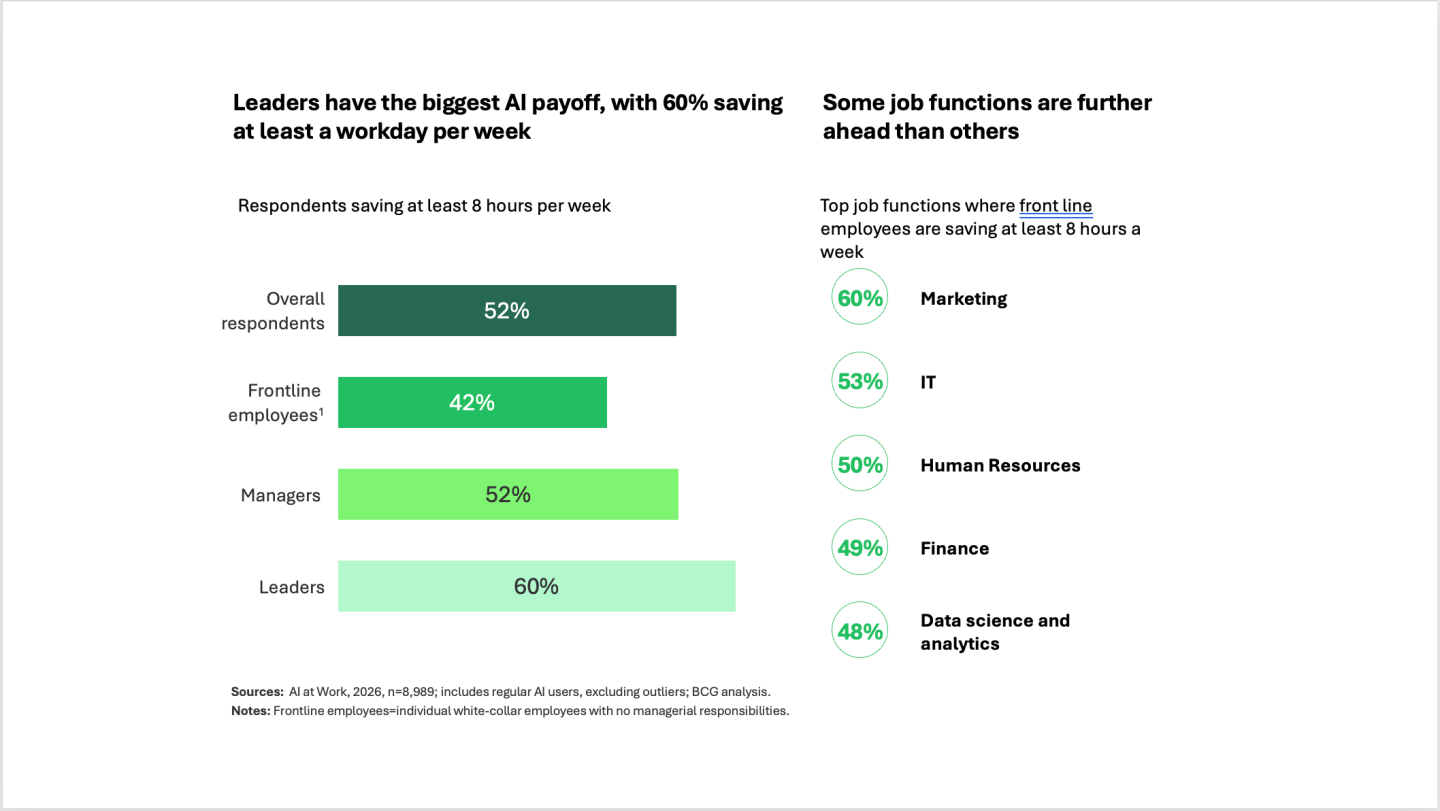
AI is saving workers a lot of time. But redirecting those savings remains a challenge. Of the frontline workers who report regularly using AI, 42% say they save eight hours per week with these tools, with time savings even higher for employees in marketing (60%), IT (53%), and human resources (50%), according to a recent global survey of 11,749 workers conducted by BCG. The consulting firm also reported that AI adoption has surged, with 74% reporting they use these tools a few times each week or even daily, up 23 percentage points from its 2025 AI at Work survey.
And yet, a vast majority of frontline workers (66%) say their organizations give little or no guidance on what to do with that time saved. Nearly nine out of ten respondents say they expect they’ll need a lot more AI upskilling in the near future, though today, just 36% believe they are properly trained.
David Martin, who leads the global people and organization practice at BCG, tells Fortune that too many companies are focused on one-hour training sessions, half-day bootcamps, and other classic learning and development programs. He shared how one Magnificent 7 company saw 90% of engineers using AI for work, but that the productivity lift didn’t match adoption. To get that second metric higher, the tech client implemented a six-week training exercise where for four hours each day the engineers would explore every single task and reframe it with AI. The second half of the day was dedicated to discussions focused on what worked and what didn’t.
“You actually have to have hands-on, immersive training, and be using it in the day-to-day work you are doing, and you have to do it extremely frequently,” Martin says. “It’s not just about awareness building, it’s about habit forming.”
Courtesy of BCG
JOBS RADAR
Hiring:
– Unitil is seeking a VP, IT and CIO, based in Hampton, New Hampshire. Posted salary range: $205.8K-$231.5K/year.
– MassChallenge is seeking a CTO, based in Boston. Posted salary range: $180K-$200K/year.
– Willis Re is seeking a technology head of AI, based in New York. Posted salary range: $184K-$276K/year.
– Autodesk is seeking a VP of commerce technology, based in Washington. Posted salary range: $291K-$426.8K/year.
Hired:
– Tata Communications named Rupesh Chokshi to serve as chief technology officer and EVP and global business head of network services. He joins the network services provider after most recently serving as a SVP at cybersecurity and cloud computing company Akamai Technologies. Previously, Chokshi held senior leadership roles at AT&T.
– Five9 announced the appointment of Niranjan Vijayaragavan as CTO, joining the call center software provider to oversee product engineering, product management, AI automation, and architecture. He joins Five9 after most recently serving as chief product and technology officer at software company Nintex. He previously held senior leadership roles at Avalara, Expedia, Microsoft and Boston Consulting Group.
– VulcanForms appointed Michael Kenworthy as CTO, joining the 3D printing company as it expands its manufacturing platform. Kenworthy will lead the company’s technology strategy, product development, and engineering roadmap. Most recently, he served as VP of engineering at aerospace manufacturer Relativity Space. Previously, Kenworthy served as chief product officer at Seurat Technologies and CTO at Divergent.
– Intact Insurance appointed Rory Meleniclis as CIO, joining the insurance provider after most recently serving as a senior director for the financial services firm Royal Bank of Canada. He also previously served as a VP at Scotiabank.
– Accuity announced the appointment of Gary Basra as CTO. He joins the healthcare technology vendor after most recently serving as CTO at employee benefits company ParetoHealth. Basra also previously served as CTO at Global Care Analytics and My Work Choice.
– Z Squared named Jeffrey Harris to the role of CTO. Harris most recently served as the founder and CTO of Paradox Data, a computing infrastructure startup that Z Squared agreed to acquire a majority stake in earlier in June. Harris also previously served in aerospace electronics and secure systems for the U.S. military.
#foodservice #giant #Sodexo #embracing #robotics #reshape #kitchen